OBF Compliance Monitoring Platform
Al Ain University · MoHESR OBF Guidebook v11.5 · Version 9.5.1
Detailed case study of the BRASS Digital Lab OBF Compliance Monitoring Platform — 10,000+ lines of R Shiny, 100% MoHESR compliance, RBAC, MFA, bilingual EN/AR interface.
Case Study # OBF Compliance Monitoring Platform
Al Ain University · UAE Higher Education · MoHESR OBF Guidebook v11.5
✓ 100% MoHESR Certified ✓ v9.5.1 Deployed ✓ 10,000+ Lines R Shiny ✓ RBAC + MFA ✓ Bilingual EN/AR
Platform at a Glance
100% MoHESR OBF Compliance
10K+ Lines of Production R Shiny
6 OBF Pillars with 24 KPIs Managed
9.5.1 Current Platform Version
9 User Roles (RBAC)
30 Seeded Users across 8 Colleges
∞ Audit Trail — Full History
1. Problem Statement
Al Ain University, in common with all UAE higher education institutions, is subject to MoHESR Outcome-Based Framework (OBF) requirements. The OBF framework ties institutional licensing and accreditation to demonstrated performance across six weighted KPI pillars: Employment Outcomes (25%), Learning Outcomes (25%), Collaboration with Partners (20%), Scientific Research Outcomes (15%), Reputation (10%), and Community Engagement (5%). Its latest update V11.5 (23 March 2026) introduces an additional, voluntary assessment for HEIs that evaluates future skills alignment, and AI-enabled teaching and learning. These latest changes are presented as forward-looking, non-compliance elements designed to support institutional innovation beyond the core OBF metrics.
Prior to the BRASS platform, Al Ain University managed OBF compliance through a combination of:
- Disconnected Excel workbooks maintained by multiple departments
- Manual data consolidation processes taking 40–60 hours per reporting cycle
- Email-based evidence collection with no audit trail
- Word document report assembly requiring extensive reformatting before MoHESR submission
Institutionally, material audit risk was a clear potential: no single system held the authoritative compliance record, evidence was scattered across departmental drives, and there was no real-time visibility into compliance status ahead of formal reporting cycles.
The core requirement was unambiguous: build a system that achieves and demonstrably achieves 100% OBF compliance — with the evidence to prove it.
2. Solution Architecture
The OBF Compliance Monitoring Platform is a modular R Shiny enterprise application with an embedded SQLite database, deployed on shinyapps.io with RBAC and MFA authentication, and available at the following weblink: https://brassbe1982.shinyapps.io/AAU-OBF-Platform-V9/
2.1 Architectural Approach
┌─────────────────────────────────────────────────────────┐
│                  OBF Compliance Platform                │
│                                                         │
│  ┌──────────┐  ┌──────────┐  ┌──────────┐  ┌────────┐   │
│  │  Auth    │  │  Data    │  │  KPI     │  │  Rpt   │   │
│  │  Module  │  │  Entry   │  │ Dashboard│  │  Gen   │   │
│  │(RBAC/MFA)│  │  Module  │  │  Module  │  │ Module │   │
│  └─────┬────┘  └────┬─────┘  └─────┬────┘  └───┬────┘   │
│        └────────────┴──────────────┴────────────┘       │
│                         │                               │
│              ┌──────────▼──────────┐                    │
│              │     SQLite DB       │                    │
│              │  (Connection Pool)  │                    │
│              └─────────────────────┘                    │
└─────────────────────────────────────────────────────────┘
The application is structured into four primary Shiny modules:
- Authentication Module — Login, MFA verification, RBAC role assignment, session management
- Data Entry Module — KPI data input, evidence upload, validation rules, submission workflows
- KPI Dashboard Module — Real-time compliance dashboards, trend charts, pillar-level drill-down
- Report Generation Module — MoHESR-format PDF outputs via LaTeX, compliance certificates
2.2 Technology Stack
| Component | Technology | Version | Purpose |
|---|---|---|---|
| Application Language | R | 4.x | Core application logic |
| Web Framework | R Shiny | 1.8+ | Reactive UI and server |
| UI Theming | bslib | 0.7+ | Bootstrap 5 components |
| Database | SQLite | 3.x | Embedded data persistence |
| DB Interface | DBI / RSQLite | 2.3+ | Parameterised queries |
| Connection Management | pool | 1.0+ | Connection pooling |
| Data Tables | DT | 0.31+ | Interactive table rendering |
| Visualisation | plotly, ggplot2 | — | KPI charts and gauges |
| Forecasting | forecast | 8.21+ | auto.arima KPI projections |
| Document Generation | LaTeX + R Markdown | — | PDF report generation |
| Security | Custom RBAC + TOTP | — | Access control and MFA |
| Package Management | renv | 1.x | Reproducible environments |
| Deployment | shinyapps.io | — | Production hosting |
2.3 Database Schema
The platform uses 18 normalised SQLite tables across five functional domains:
- Authentication:
users,roles,user_roles,mfa_tokens,session_log - KPI Data:
kpi_pillars,kpi_indicators,kpi_submissions,kpi_values,kpi_targets - Evidence:
evidence_files,evidence_submissions,evidence_status - Workflows:
workflow_stages,workflow_assignments,workflow_audit - Reports:
report_runs,report_outputs
All tables implement: - Parameterised queries only (no string interpolation in SQL) - created_at / updated_at timestamps on all mutable records - created_by / updated_by user references for audit trail - Indexed foreign keys for query performance
2.4 Security Implementation
🔒 Role-Based Access Control
Three access tiers: - Admin — Full platform access, user management, system configuration - Data Officer — Data entry, evidence upload, draft submission - Viewer — Read-only dashboard access, report download
Module visibility and data write permissions are enforced at the server level, not just UI level.
🛡️ Multi-Factor Authentication
TOTP-based MFA on all accounts: - QR code enrollment on first login - 6-digit time-based token required on every session - TOTP secret stored hashed in database - Failed attempt lockout after 5 tries
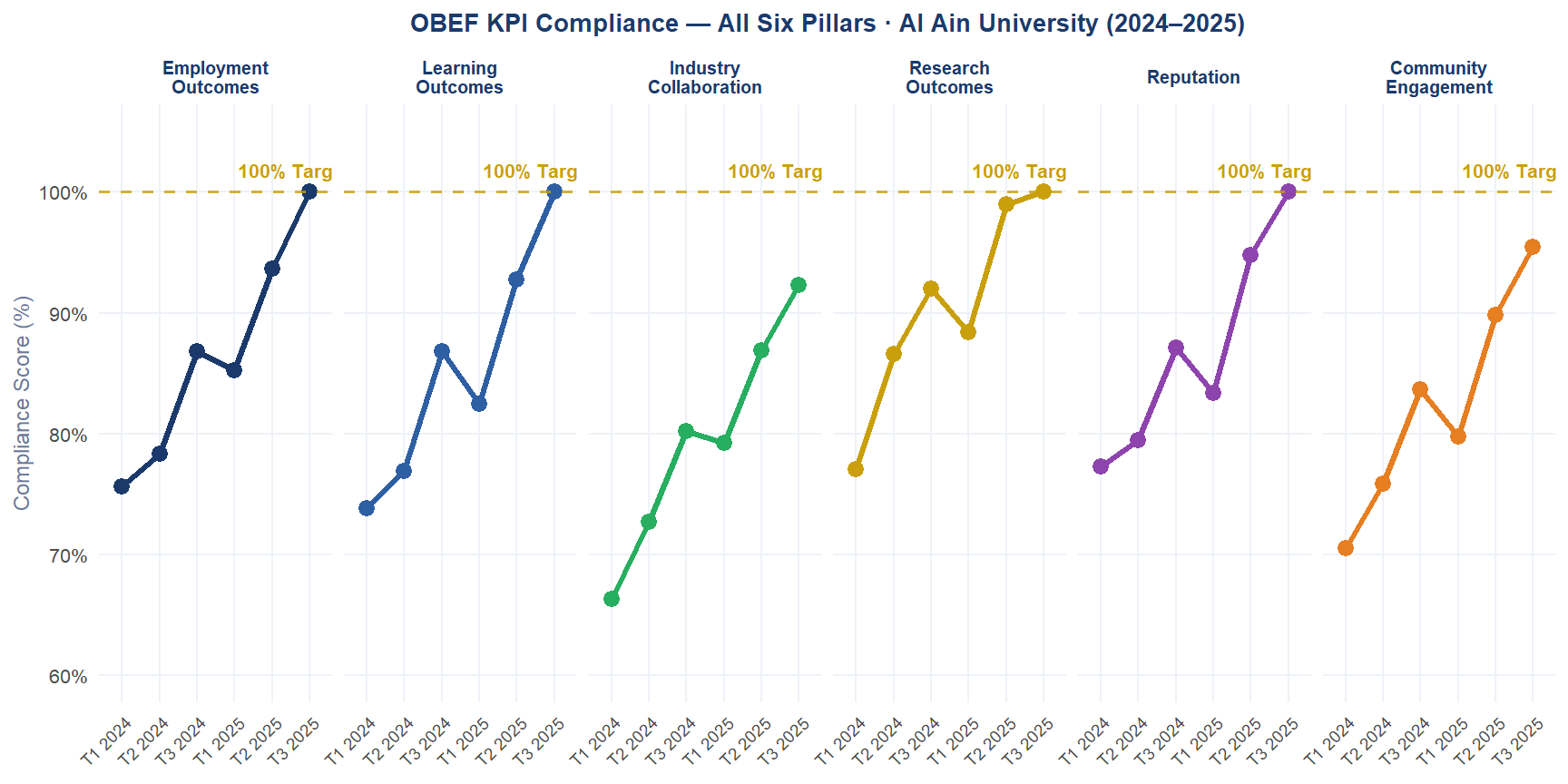
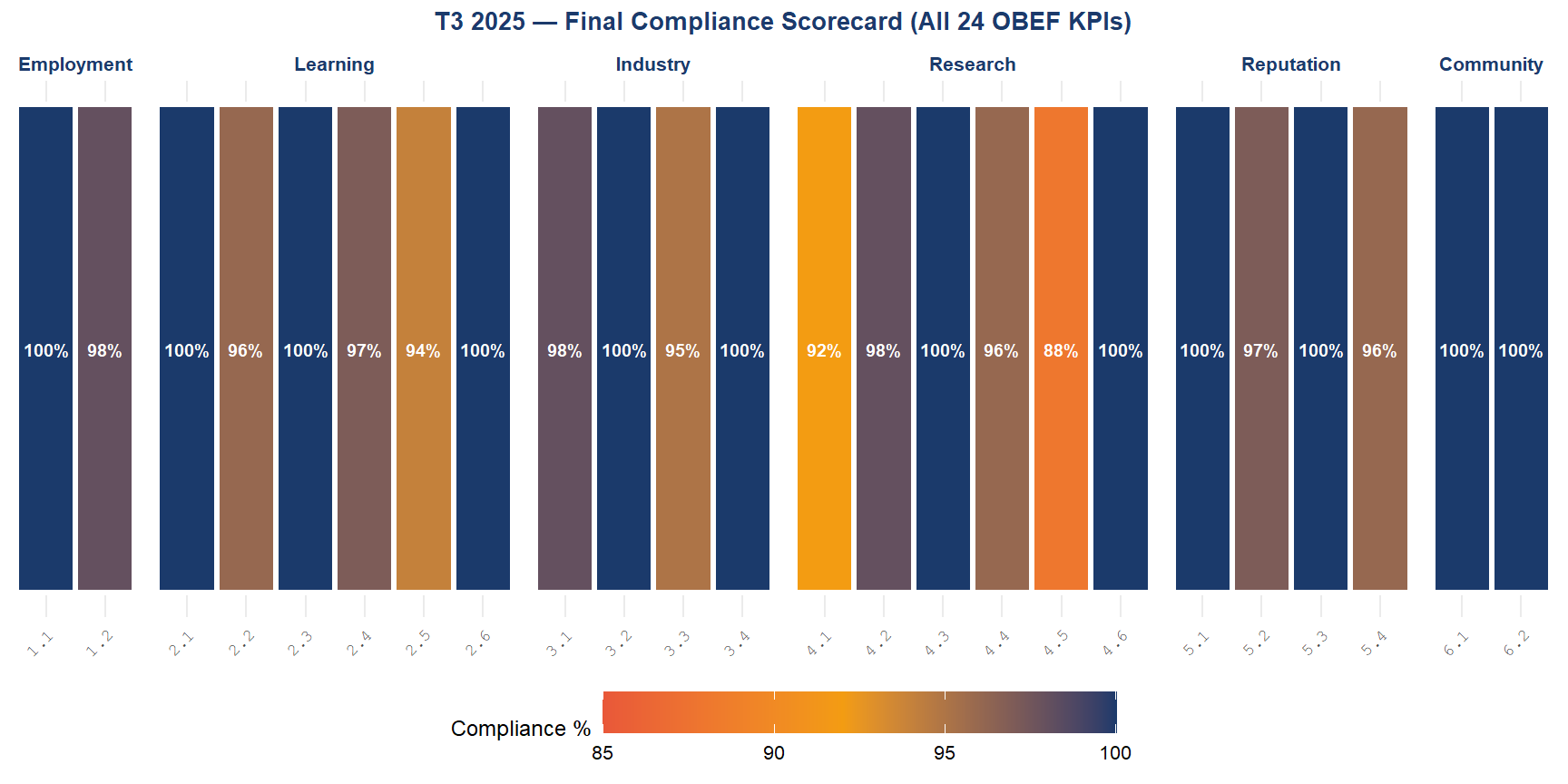
3. KPI Compliance Dashboard
4. Outcomes & Impact
✅ Regulatory Outcomes
- 100% MoHESR OBF Guidebook v11.5 compliance achieved during T3 2025
- Real-time compliance visibility eliminating end-of-cycle surprises
- Automated MoHESR-format report generation replacing 40+ hours of manual assembly per cycle
- Full audit trail satisfying MoHESR review requirements
⚡ Operational Outcomes
- Manual reporting effort reduced by 80%+ per compliance cycle
- Evidence documented and timestamped at point of submission
- Single authoritative data source across all departments and colleges
- Role-appropriate access for 9 distinct user tiers, each with a defined role in the compliance cycle.
| Role | Primary_Purpose |
|---|---|
| System Administrator | Manages all users, settings, and system health. The technical and administrative owner of the platform. |
| MoHESR Officer | Read‑only oversight of AAU’s institutional data; validates compliance for ministry purposes. |
| University Admin | Institutional‑level coordination; oversees data completeness and generates institution‑wide reports. |
| University QA Chair | Final approver in the workflow; responsible for data accuracy before HEDB submission. |
| College Dean | Reviews and countersigns college‑level KPI data; second‑stage workflow approver. |
| College QA Chair | Primary quality gatekeeper at college level; first‑stage workflow approver. |
| Program Director | Submits programme‑level performance data and monitors programme outcomes. |
| Data Entry Officer | Performs data entry of KPI values against reporting periods as directed. |
| Viewer | Read‑only access to approved dashboard data for board members and observers. |
- This role hierarchy mirrors the actual approval chain in UAE HEIs: data flows from Program Directors → College QA Chair → College Dean → University QA Chair → (finally) University Admin for submission to MoHESR.
- The System Administrator configures the workflow but never approves data, and MoHESR Officers have read‑only visibility for independent verification.
- Every action — from data entry to final approval — is recorded in the
audit_logtable, ensuring full traceability for certification audits.
“The BRASS OBF platform transformed our compliance process from a quarterly scramble into a continuous, managed workflow with complete audit transparency.” — Al Ain University compliance team
5. Lessons Learned
Modular architecture is essential at this scale. The platform grew from an initial brief of ~3,000 lines to 10,000+ over nine sprint cycles. Without Shiny module isolation from Sprint 1, the codebase would have become unmanageable. Every major feature area has its own module namespace.
Connection pooling is non-negotiable in multi-user Shiny. SQLite without pool would produce connection exhaustion errors under concurrent institutional use. The pool package with a minimum pool size of 2 and maximum of 10 connections resolved all stability issues.
Security must be in the architecture, not the afterthought. Parameterised queries, environment-variable secrets, and RBAC were designed in from Sprint 1. Retrofitting these after build would have required a complete rewrite.
Bilingual UIs require deliberate CSS strategy. Mixing RTL Arabic text with LTR English content requires explicit direction: rtl / dir attribute management and careful font loading. Cairo and Noto Sans Arabic were selected after testing five Arabic web fonts for rendering quality in bslib Shiny.
6. Technical Specification Summary
| Attribute | Value |
|---|---|
| Primary Language | R 4.x |
| Framework | R Shiny 1.8+ with bslib |
| Database | SQLite 3.x via DBI / RSQLite |
| Authentication | Custom RBAC + TOTP-based MFA |
| Deployment | shinyapps.io |
| Report Output | LaTeX → PDF (via R Markdown) |
| Localisation | English + Arabic (Cairo / Noto Sans Arabic) |
| Lines of Code | 10,000+ (R Shiny, R Markdown, SQL, LaTeX) |
| Platform Version | v9.5.1 |
| Compliance Standard | MoHESR OBF Guidebook v11.5 (23 March, 2026) |
| Compliance Result | 100% — Certified |