RegTech vs. Excel vs. International Vendors: The Real Cost of OBF Compliance
A Structured Cost Comparison for UAE HEI Decision-Makers
Compliance
Strategy
Advisory
A structured comparison of the three approaches UAE higher education institutions use to manage OBF compliance — manual/Excel, international RegTech vendors, and purpose-built R Shiny platforms — analysed by total cost, risk, and regulatory outcomes.
Strategy · Advisory # RegTech vs. Excel vs. International Vendors
The real cost of OBF compliance — across manual processes, international RegTech platforms, and purpose-built R Shiny solutions. A structured analysis for UAE HEI procurement teams and institutional leadership.
12 min read Strategy Advisory Procurement
The Three Approaches
Every UAE higher education institution managing OBF compliance falls into one of three approaches:
- Manual/Excel — OBF data managed through spreadsheets, Word documents, email, and manual report assembly
- International RegTech vendor — a generic compliance or quality management platform from an international software vendor, adapted for OBF requirements
- Purpose-built platform — an OBF compliance platform built specifically for the MoHESR regulatory framework, such as BRASS Digital Lab’s Edu-RegTech OBF Platform
This analysis compares the three approaches across the dimensions that matter most for institutional decision-making: total cost of ownership, compliance risk, operational overhead, and regulatory outcomes.
Approach 1: Manual / Excel
How It Works
The compliance coordinator maintains a set of Excel workbooks — one per OBF pillar, or one per academic term — into which data is manually entered by departmental representatives, usually via email requests. Report assembly involves consolidating data across workbooks, reformatting to MoHESR’s required layout, and generating a Word or PDF document for submission.
True Cost
The cost of manual OBF compliance is primarily staff time — which is systematically underestimated in institutional planning:
| Cost Element | Estimate per Reporting Cycle |
|---|---|
| Data collection (email-based, across departments) | 15–25 hours coordinator time |
| Data validation and error correction | 8–15 hours |
| Workbook consolidation | 6–10 hours |
| Report assembly and formatting | 10–20 hours |
| Review and approval iterations | 4–8 hours |
| Total per cycle (conservative) | 43–78 hours |
At AED 100–150/hour for a compliance coordinator, this is AED 4,300–11,700 per reporting cycle in direct labour cost alone — before accounting for departmental staff time providing data.
For three reporting cycles per year, the direct staff cost is AED 12,900–35,100 annually, with no institutional asset (data, platform, or system) created.
Compliance Risk
Manual processes create four categories of compliance risk:
- Data integrity risk: No single authoritative source; different figures in different workbooks
- Audit trail risk: No timestamp or user record for data changes; unverifiable data provenance
- Error risk: Manual reformatting for MoHESR submission regularly introduces format errors
- Version risk: When MoHESR releases a new Guidebook version, every template must be manually updated
Regulatory Outcome
Most institutions using manual processes submit technically compliant data — but under MoHESR review, the inability to demonstrate data provenance and audit trail is a vulnerability. As MoHESR review processes mature and become more documentation-intensive, institutions without structured evidence trails face increasing scrutiny.
Approach 2: International RegTech Vendor
How It Works
A generic compliance management platform — typically sold under branding such as “quality management system,” “accreditation management,” or “regulatory compliance platform” — is licensed from an international vendor and configured to approximate OBF requirements.
Vendors in this category include SAP GRC, ServiceNow GRC, MasterControl, NAVEX, and various smaller SaaS compliance tools.
True Cost
International RegTech platforms carry significant cost across multiple dimensions:
| Cost Element | Typical Range |
|---|---|
| Annual software licence (per-seat, SaaS) | AED 80,000–250,000/year |
| Implementation and configuration | AED 120,000–400,000 (one-time) |
| Customisation for OBF-specific requirements | AED 50,000–200,000 (one-time) |
| Annual support and maintenance | AED 30,000–80,000/year |
| Training | AED 20,000–60,000 |
| Year 1 total cost | AED 300,000–990,000 |
| Ongoing annual cost | AED 110,000–330,000/year |
These figures represent approximate ranges based on publicly available vendor pricing and UAE implementation projects. Actual costs vary by vendor, institution size, and negotiation.
Compliance Fit
International RegTech platforms are built for international compliance frameworks — ISO standards, GDPR, SOX, or sector-specific US/EU frameworks. Adapting them to MoHESR’s OBF Guidebook v11 requires:
- Custom field configuration for each of the OBF’s specific KPI indicators
- Custom calculation logic for MoHESR-prescribed KPI methodologies
- Custom report templates for MoHESR’s required submission format
- Custom Arabic language interface (where the vendor supports it at all)
- Re-configuration whenever MoHESR releases a new Guidebook version
In practice, international platforms achieve approximately 70–80% fit with OBF requirements out of the box; the remaining 20–30% is customisation — at a substantial cost.
Regulatory Outcome
International platforms that are correctly configured achieve OBF compliance. However, the configuration effort is significant, the ongoing maintenance cost is high, and the institutional team remains dependent on the vendor for every OBF Guidebook version update.
Approach 3: Purpose-Built R Shiny Platform
How It Works
An OBF compliance platform built specifically for the MoHESR regulatory framework — designed from the data model through to the report template to produce exactly what MoHESR requires, at every level of the OBF hierarchy.
True Cost
| Cost Element | Indicative Range |
|---|---|
| Platform build (fixed-price, one-off) | AED 80,000–160,000 |
| Annual SaaS subscription (hosted, maintained) | AED 40,000–80,000/year |
| OBF Guidebook version updates | Included in subscription |
| Arabic language interface | Included as standard |
| Year 1 total cost | AED 120,000–240,000 |
| Ongoing annual cost | AED 40,000–80,000/year |
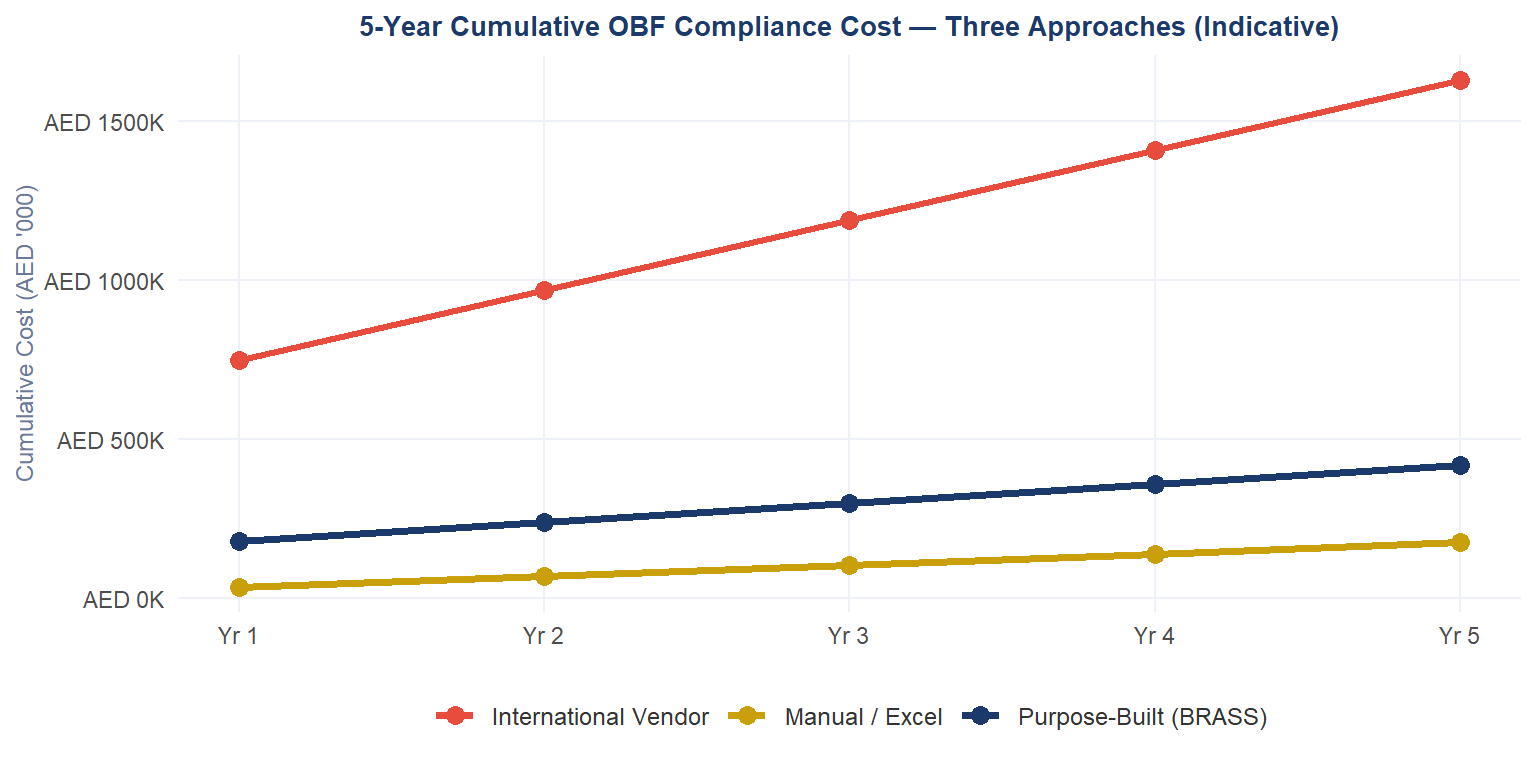
The 5-year total cost of ownership for a purpose-built platform is significantly lower than an international vendor, and the asset created (the platform and its data) belongs to the institution.
Compliance Fit
A purpose-built platform achieves 100% OBF fit by design — because it is engineered specifically for MoHESR’s requirements. Every KPI indicator, calculation methodology, and report format is built to specification. There is no configuration gap.
Regulatory Outcome
BRASS Digital Lab’s OBF Platform blueprint has achieved 100% MoHESR OBF Guidebook v11.5 compliance. This is not a claim about theoretical capability — it is a documented fact that allows each of our developed OBF platforms for UAE HEIs to be fully compliant with MoHESR regulatory requirements.
Direct Comparison
| Dimension | Manual / Excel | International Vendor | Purpose-Built (BRASS) |
|---|---|---|---|
| Year 1 total cost | AED 35K (staff only) | AED 300K–990K | AED 120K–240K |
| 5-year cumulative cost | AED 175K | AED 1.4M+ | AED 300K–560K |
| OBF framework fit | Partial (manual adaptation) | 70–80% (requires customisation) | 100% (built for OBF) |
| Arabic language support | Manual | Vendor-dependent (often absent) | Standard |
| Audit trail | None | Platform-dependent | Full, built-in |
| MoHESR version updates | Manual (high effort) | Vendor-dependent (extra cost) | Included |
| Compliance certification | At risk | Possible with customisation | 100% (documented) |
| Operational overhead | High (40–80 hrs/cycle) | Medium | Low (automated) |
| Platform ownership | None | Vendor (licence) | Institution (codebase) |
The Decision Framework
For UAE HEI procurement teams, the decision between approaches reduces to three questions:
1. What is your tolerance for compliance risk? Manual processes carry material audit and data integrity risk. If a MoHESR review finds unverifiable data provenance, the consequences — remediation requirements, reputational impact, potential licence conditions — cost far more than a platform build.
2. What is your priority: lowest upfront cost or lowest total cost of ownership? Manual appears cheapest upfront because staff time is already budgeted. But it creates no institutional asset, and the cumulative staff cost over five years exceeds a purpose-built platform build.
3. Does the platform need to be UAE OBF-specific, or do you need a generic compliance system for multiple frameworks? If your primary driver is MoHESR OBF compliance, a generic international platform adapted for OBF costs more, fits less well, and produces higher ongoing maintenance burden than a purpose-built system. If you need a single platform covering OBF, ISO, and other international frameworks simultaneously, a generic platform may have a case — but evaluate the OBF fit gap honestly.