The Impact of Artificial Intelligence on Fresh Graduate Labor Demand: A Theoretical and Empirical Analysis with Industry and Firm Heterogeneity
CES Production Function, Monte Carlo Simulation, and Policy Analysis of AI’s Dual Role in Graduate Labour Markets
Agentic Innovation Economics
A peer-reviewed IEEE conference paper modelling AI’s dual role — substitution and complementarity — in fresh graduate labour demand using a CES production framework, Monte Carlo simulation (500 replications, 1,000 firms), and policy counterfactuals. Published at the 2025 Global Congress on Emerging Technologies (GCET), IEEE, Lyon, France.
1 Abstract
This study investigates the impact of artificial intelligence (AI) on fresh graduate labor demand, emphasizing industry and firm-level heterogeneity. Using a CES production function, we model AI’s dual role in substituting and complementing graduate labor, deriving hypotheses on AI productivity, wages, and substitution elasticity. The analysis integrates a comprehensive literature review, highlighting AI’s effects on labor markets, skills adaptation, and policy needs. Empirical implications suggest targeted educational reforms and policy interventions to enhance graduate employability in AI-driven economies. The study contributes to understanding AI’s heterogeneous impacts, offering insights for academia, industry, and policymakers.
Keywords: Artificial Intelligence, Graduate Labor Demand, Industry Heterogeneity, Firm Heterogeneity, CES Production Function
2 Introduction
The rapid advancement of artificial intelligence (AI) marks a transformative era in global labor markets, reminiscent of past technological revolutions such as mechanization in the 19th century and electrification in the early 20th century. Unlike its predecessors, AI’s ability to automate cognitive and analytical tasks—once the domain of skilled human labor—has profound implications for fresh graduates entering the workforce. Since the 1980s, automation has progressively displaced routine manual and clerical tasks, with AI accelerating this trend by targeting roles requiring problem-solving, data analysis, and decision-making (Autor, Levy, and Murnane 2003). Recent data underscore the scale of this transformation: in 2023, 35% of global firms adopted AI, a significant rise from 20% in 2017 (Kar 2023). In the U.S., AI-related job postings surged by 20% annually from 2015 to 2023, with a notable wage premium for graduates possessing AI skills (Pouliakas 2025). Yet, this technological shift also poses risks, as studies estimate that 47% of jobs, particularly those involving routine tasks, are susceptible to automation (Frey and Osborne 2017).
The dual nature of AI’s impact—substituting routine tasks while creating demand for non-routine, cognitive roles—presents both opportunities and challenges for fresh graduates. In industries like technology and finance, AI complements human skills, increasing demand for graduates with expertise in data science, machine learning, and creative problem-solving. Conversely, in sectors like retail and manufacturing, where AI substitutes for entry-level roles, graduates face heightened displacement risks. This heterogeneity across industries and firms is further complicated by regional disparities and firm-specific factors, such as AI adoption intensity and capital availability. For instance, innovation-driven economies in Europe and market-driven regions in China report positive employment effects for skilled graduates (Guarascio and Reljic 2025; Chang 2025), while marginalized groups, including Black and Latino graduates, face disproportionate displacement in routine-task roles (Broady et al. 2025).
Despite the growing literature on AI’s labor market effects, significant gaps remain (Evans 2025). Existing studies often focus on aggregate impacts, overlooking firm-level heterogeneity and the long-term implications for graduates. Cross-cultural analyses are scarce, limiting the generalizability of findings across diverse economic contexts. Moreover, while dynamic modeling and policy evaluations are critical for addressing AI-driven disruptions, few studies incorporate these approaches. The lack of longitudinal research further hinders understanding of how AI shapes graduate career trajectories over time.
This study addresses these gaps by developing a theoretical and empirical framework to analyze AI’s impact on fresh graduate labor demand, with a focus on industry and firm heterogeneity. Using a Constant Elasticity of Substitution (CES) production function, we model AI’s dual role in substituting and complementing graduate labor, deriving testable hypotheses on the effects of AI productivity, wages, and substitution elasticity. The analysis is grounded in a comprehensive literature review that synthesizes insights on labor market dynamics, educational adaptations, and policy needs. By integrating theoretical modeling with empirical implications, the study aims to:
- Develop a CES-based model capturing the heterogeneous effects of AI on graduate labor demand across industries and firms.
- Synthesize the literature to identify key themes, gaps, and emerging trends in AI’s labor market impacts, skills requirements, and policy interventions.
- Propose testable hypotheses and policy counterfactuals to enhance graduate employability in AI-driven economies.
The study contributes to the literature in three key ways. First, it provides a novel theoretical model that explicitly accounts for industry and firm-level heterogeneity, offering a nuanced understanding of AI’s impact on graduate labor demand. Second, it integrates a comprehensive literature review to contextualize the model and highlight research gaps, such as the need for longitudinal and cross-cultural studies. Third, it proposes policy recommendations, including targeted educational reforms and wage subsidies, to promote equitable labor market transitions for graduates. These contributions offer valuable insights for academia, industry stakeholders, and policymakers navigating the AI-driven economic landscape.
The paper is structured as follows: Section 3 reviews the literature on AI’s labor market effects, skills adaptation, and policy implications. Section 4 presents the theoretical model and hypotheses. Section 5 outlines the methodology, including the simulation framework and empirical strategies. Section 6 and Section 7 discuss results, implications, and conclusions.
3 Literature Review
3.1 AI’s Impact on Labor Market Dynamics
The literature consistently highlights AI’s dual role in labor markets: substituting routine tasks while creating new opportunities for non-routine, cognitive roles. Acemoglu & Restrepo (2018, 2019, 2020) provide a theoretical foundation, modeling AI as a technology that automates routine tasks but reinstates labor through new task creation. Their empirical work in U.S. labor markets shows that automation reduces demand for low-skilled jobs but increases demand for high-skilled roles, benefiting graduates with advanced technical skills. Similarly, Bessen et al. (2020) find that automation can boost employment in contexts where AI complements human skills, such as data analysis or creative problem-solving, which are critical for graduates.
Frey and Osborne (2017) estimate that 47% of jobs are at high risk of automation, with graduates in non-routine roles (e.g., management, creative industries) facing lower risks. Caravella and Menghini (2018) echo this, finding that Italian professions requiring social and creative skills are less substitutable, offering opportunities for graduates with such competencies. In contrast, Broady et al. (2025) highlight the disproportionate impact of AI on Black and Latino workers in routine-task roles, suggesting that graduates from these groups may face higher displacement risks unless equipped with AI-complementary skills.
Chang (2025) and Guarascio and Reljic (2025) provide region-specific insights, showing positive employment effects in China’s financial sector and Europe’s innovation-driven economies, respectively. These findings suggest that graduates in regions with strong AI adoption may benefit from increased demand for technical skills. However, Occhipinti et al. (2025) warn of recessionary pressures from generative AI, which could reduce graduate opportunities in cognitive roles unless mitigated by policy. Pouliakas (2025) identify a wage premium for AI programmers, driven by higher skill requirements and performance-based pay, indicating strong demand for graduates with specialized AI skills. Huseynov (2025) note that non-STEM graduates perceive greater vulnerability to AI, affecting their earning expectations and highlighting the need for targeted educational interventions.
Yang and Wang (2025) and Shabu and Kumar (2025) explore AI’s role in transforming employment structures, particularly in gig and platform economies. Graduates entering these markets face increased precarity but also opportunities in roles requiring digital proficiency. Akimov (2016) suggest that labor-saving technologies can address labor shortages in aging economies but may reduce demand for low-skilled graduate roles, emphasizing the need for upskilling.
Methodologically, these studies employ diverse approaches. Acemoglu and Restrepo (2020) use regression discontinuity designs to estimate automation’s employment effects, while Pouliakas (2025) apply wage decomposition to isolate AI skill premiums. Cattaneo, Gschwendt, and Wolter (2025) utilize survey experiments to capture behavioral responses to automation risks, and Guarascio and Reljic (2025) leverage panel data to analyze cross-country heterogeneity. These methodologies underscore the importance of accounting for industry and regional variations, aligning with the proposed simulation framework’s focus on heterogeneity.
3.2 Skills and Educational Adaptation
AI’s impact on graduate labor demand necessitates significant educational reforms to align skills with market needs. Autor, Levy, and Murnane (2003) introduce the task-based framework, emphasizing non-routine cognitive and interpersonal skills as critical for graduates in AI-driven markets. Sianesi (2003) highlight the macroeconomic returns to education, suggesting that AI literacy enhances graduate employability. Imjai et al. (2025) demonstrate that an AI mindset, experiential learning, and soft skills significantly enhance career readiness for Thai accounting graduates, with soft skills playing a mediating role. Similarly, Park (2025) show that LLMs foster creativity and problem-solving in entrepreneurship education, benefiting graduates in dynamic industries.
Ngo, Nguyen, and Vu (2025) propose an adaptive innovation ecosystem in Vietnam, integrating AI-driven skills forecasting and lifelong learning to address skills mismatches. Fernández-Munín and García-Doval (2025) advocate for AI integration in Spain’s vocational training, emphasizing continuous learning to prepare graduates for digitized labor markets. Klevtsov et al. (2025) explore dual training models that combine AI education with industry collaboration, enhancing graduate employability. Dincă et al. (2019) highlight the importance of global skills, including AI literacy, for Scottish graduates amidst Brexit uncertainties. Petz and Darázs (2006) emphasize accessible IT training to improve employability for graduates with disabilities.
These studies predominantly use qualitative and mixed-methods approaches. Imjai et al. (2025) employ Partial Least Squares Structural Equation Modeling (PLS-SEM) to analyze mediating effects, while Park (2025) use PRISMA for systematic reviews. Ngo, Nguyen, and Vu (2025) combine Causal Layered Analysis with scenario planning, offering a forward-looking approach to skills development. These methodologies support the simulation framework’s emphasis on aligning educational outcomes with AI-driven labor demands.
3.3 Policy and Ethical Considerations
AI’s transformative impact requires robust policy interventions to mitigate displacement and promote equitable opportunities for graduates. Aghion, Jones, and Jones (2019) model AI’s contribution to economic growth, advocating for wage subsidies to offset displacement effects. Autor, Mindell, and Reynolds (2020) propose retraining programs to enhance graduate resilience, while OECD (2020) recommend social safety nets and reskilling initiatives. Kar (2023) emphasize data-driven policies to align education with labor market needs.
Serrano and Garcia (2025) examines the EU AI Act, advocating for human-centered frameworks to balance innovation and employment stability. Giri and Sharma (2025) highlight ethical concerns, such as bias and transparency, calling for inclusive policies to support graduates. Güler (2025) addresses precarity in AI-driven gig economies, suggesting policies to protect flexible workers. Jeong and Sung (2025) analyze public perceptions of generative AI, identifying labor market concerns and the need for human-centered policies.
Methodologically, these studies rely on theoretical modeling (Aghion, Jones, and Jones 2019), case studies (Giri and Sharma 2025), and structural topic modeling (Jeong and Sung 2025). The proposed simulation framework’s policy counterfactuals, such as wage subsidies and AI training programs in this study, align with these recommendations, emphasizing proactive interventions to support graduate labor demand.
4 Methodology
4.1 Theoretical Foundations
The theoretical underpinnings of AI’s impact on graduate labor demand are rooted in task-based and skill-biased technological change (SBTC) frameworks. Autor, Levy, and Murnane (2003) and Acemoglu and Restrepo (2019) argue that technologies like AI substitute routine tasks while complementing non-routine cognitive tasks, increasing demand for graduates with analytical and creative skills. Acemoglu and Restrepo (2018) and Acemoglu and Restrepo (2020) extend this by modeling AI’s dual effects: displacement of routine tasks and reinstatement through new task creation. Aghion, Jones, and Jones (2019) provide a growth model, showing that AI enhances productivity but may exacerbate inequality without policy interventions. Katz and Murphy (1992) highlight supply-demand dynamics, suggesting that AI increases demand for skilled graduates, widening wage gaps. Brynjolfsson and McAfee (2014) and Brynjolfsson, Rock, and Syverson (2018) discuss the productivity paradox, where AI’s benefits lag due to adoption barriers, affecting graduate employment transitions.
4.2 Economic Model Setup
Consider an economy with I industries, indexed by i = 1, \dots, I, each containing J_i firms, indexed by j = 1, \dots, J_i. Each firm j in industry i produces output Y_{ij} using a Constant Elasticity of Substitution (CES) production function:
\begin{aligned} Y_{ij} &= A_{ij} \left[ \gamma_i L_{g,ij}^{\rho_i} + (1-\gamma_i) L_{A,ij}^{\rho_i} \right]^{\frac{\alpha_i}{\rho_i}} K_{ij}^{1-\alpha_i}, \\ &\quad 0 < \alpha_i, \gamma_i < 1, \quad \rho_i \leq 1 \end{aligned} \tag{1}
- Y_{ij}: Output of firm j in industry i.
- K_{ij}: Capital input, fixed at \bar{K}_{ij} in the short run.
- L_{g,ij}: Labor input from fresh graduates (hours or workers).
- L_{A,ij}: AI-driven labor input (e.g., automated systems).
- A_{ij} = A_i \cdot \phi_{ij}: Firm-specific productivity, where A_i is industry-level AI adoption intensity, and \phi_{ij} \sim \text{Lognormal}(\mu_i, \sigma_i^2) captures firm-specific efficiency.
- \gamma_i: Industry-specific share parameter for graduate labor.
- \rho_i: Industry-specific substitution parameter, with elasticity of substitution \sigma_i = \frac{1}{1-\rho_i}.
- \alpha_i: Industry-specific share parameter for the labor composite.
Industry Heterogeneity: Industries differ in \gamma_i (graduate labor intensity), \rho_i (substitutability), \alpha_i (capital intensity), and A_i (AI adoption). For example, tech industries may have high A_i and low \sigma_i (complementarity), while manufacturing has lower A_i and higher \sigma_i (substitution).
Firm Heterogeneity: Firms within an industry vary in \phi_{ij} (AI efficiency) and \bar{K}_{ij} (capital stock), reflecting differences in size or AI investment.
The firm’s profit function is:
\begin{aligned} \pi_{ij} &= A_{ij} \left[ \gamma_i L_{g,ij}^{\rho_i} + (1-\gamma_i) L_{A,ij}^{\rho_i} \right]^{\frac{\alpha_i}{\rho_i}} K_{ij}^{1-\alpha_i} \\ &\quad - w_{g,i} L_{g,ij} - w_{A,i} L_{A,ij} - r_i K_{ij} \end{aligned} \tag{2}
where w_{g,i}, w_{A,i}, and r_i are industry-specific wages for graduates, AI labor costs, and capital rental rates, respectively. Output price is normalized to 1.
Profit Maximization
The firm maximizes profit by choosing L_{g,ij}, L_{A,ij}, and K_{ij}. We focus on the short run with fixed capital \bar{K}_{ij}. The first order conditions (FOC) for L_{g,ij} are obtained as:
\begin{aligned} \frac{\partial Y_{ij}}{\partial L_{g,ij}} &= \alpha_i A_{ij} \gamma_i L_{g,ij}^{\rho_i-1} \left[ \gamma_i L_{g,ij}^{\rho_i} + (1-\gamma_i) L_{A,ij}^{\rho_i} \right]^{\frac{\alpha_i-\rho_i}{\rho_i}} K_{ij}^{1-\alpha_i} \\ &= w_{g,i} \end{aligned} \tag{3}
Similarly, the FOC for L_{A,ij} are:
\begin{aligned} \frac{\partial Y_{ij}}{\partial L_{A,ij}} &= \alpha_i A_{ij} (1-\gamma_i) L_{A,ij}^{\rho_i-1} \left[ \gamma_i L_{g,ij}^{\rho_i} + (1-\gamma_i) L_{A,ij}^{\rho_i} \right]^{\frac{\alpha_i-\rho_i}{\rho_i}} K_{ij}^{1-\alpha_i} \\ &= w_{A,i} \end{aligned} \tag{4}
Also, the FOC for K_{ij} are:
\begin{aligned} \frac{\partial Y_{ij}}{\partial K_{ij}} &= (1-\alpha_i) A_{ij} \left[ \gamma_i L_{g,ij}^{\rho_i} + (1-\gamma_i) L_{A,ij}^{\rho_i} \right]^{\frac{\alpha_i}{\rho_i}} K_{ij}^{-\alpha_i} \\ &= r_i \end{aligned} \tag{5}
Labor Demand for Fresh Graduates
Dividing the FOC for L_{g,ij} by the FOC for L_{A,ij}:
\frac{\gamma_i L_{g,ij}^{\rho_i-1}}{(1-\gamma_i) L_{A,ij}^{\rho_i-1}} = \frac{w_{g,i}}{w_{A,i}}
\begin{aligned} \frac{L_{A,ij}}{L_{g,ij}} &= \left( \frac{w_{g,i} (1-\gamma_i)}{w_{A,i} \gamma_i} \right)^{\frac{1}{\rho_i-1}} \\ &= \left( \frac{w_{g,i} (1-\gamma_i)}{w_{A,i} \gamma_i} \right)^{-\sigma_i} \end{aligned} \tag{6}
Let c_{ij} = \left( \frac{w_{g,i} (1-\gamma_i)}{w_{A,i} \gamma_i} \right)^{-\sigma_i}, so L_{A,ij} = c_{ij} L_{g,ij}.
Substituting into the FOC for L_{g,ij} with K_{ij} = \bar{K}_{ij}:
\begin{aligned} w_{g,i} &= \alpha_i A_{ij} \gamma_i L_{g,ij}^{\rho_i-1} \\ &\quad \times \left[ \gamma_i L_{g,ij}^{\rho_i} + (1-\gamma_i)(c_{ij}L_{g,ij})^{\rho_i} \right]^{\frac{\alpha_i-\rho_i}{\rho_i}} \\ &\quad \times \bar{K}_{ij}^{1-\alpha_i} \end{aligned} \tag{7}
Then:
L_{g,ij}^{\rho_i-1} L_{g,ij}^{\alpha_i-\rho_i} \times \left[ \gamma_i + (1-\gamma_i)c_{ij}^{\rho_i} \right]^{\frac{\alpha_i-\rho_i}{\rho_i}} = \frac{w_{g,i}}{\alpha_i A_{ij} \gamma_i \bar{K}_{ij}^{1-\alpha_i}} \tag{8}
Finally:
L_{g,ij}^{\alpha_i-1} = \frac{w_{g,i}}{\alpha_i A_{ij} \gamma_i \left[ \gamma_i + (1-\gamma_i) c_{ij}^{\rho_i} \right]^{\frac{\alpha_i-\rho_i}{\rho_i}} \bar{K}_{ij}^{1-\alpha_i}} \tag{9}
\begin{aligned} L_{g,ij} &= \left( \frac{\alpha_i A_{ij} \gamma_i \bar{K}_{ij}^{1-\alpha_i}}{w_{g,i}} \right)^{\frac{1}{\alpha_i-1}} \\ &\quad \times \left[ \gamma_i + (1-\gamma_i)c_{ij}^{\rho_i} \right]^{\frac{\alpha_i-\rho_i}{\rho_i(1-\alpha_i)}} \end{aligned} \tag{10}
4.3 Comparative Static Analyses
As shown below, the comparative static results are obtained by deriving the effects of changes in A_{ij}, w_{g,i}, w_{A,i}, and \sigma_i on L_{g,ij}.
Effect of AI Productivity (A_{ij})
Let d_i = \frac{\alpha_i \gamma_i \bar{K}_{ij}^{1-\alpha_i}}{w_{g,i}}, e_i = \gamma_i + (1-\gamma_i) c_{ij}^{\rho_i}. Then:
L_{g,ij} = (d_i A_{ij})^{\frac{1}{\alpha_i-1}} e_i^{\frac{\alpha_i-\rho_i}{\rho_i (1-\alpha_i)}}
\frac{\partial L_{g,ij}}{\partial A_{ij}} = \frac{1}{\alpha_i-1} (d_i A_{ij})^{\frac{1}{\alpha_i-1}-1} d_i e_i^{\frac{\alpha_i-\rho_i}{\rho_i (1-\alpha_i)}} = \frac{1}{\alpha_i-1} \cdot \frac{L_{g,ij}}{A_{ij}} \tag{11}
Elasticity:
\frac{\partial L_{g,ij}}{\partial A_{ij}} \cdot \frac{A_{ij}}{L_{g,ij}} = \frac{1}{\alpha_i-1}
Since \alpha_i < 1, the elasticity is negative in sign due to the exponent, but the demand function implies a positive relationship (higher A_{ij} increases L_{g,ij} in complementary regimes).
Effect of Graduate Wages (w_{g,i})
Since d_i \propto w_{g,i}^{-1}, c_{ij} \propto w_{g,i}^{-\sigma_i}:
\frac{\partial L_{g,ij}}{\partial w_{g,i}} = \frac{1}{\alpha_i-1}(d_i A_{ij})^{\frac{1}{\alpha_i-1}} \cdot \frac{-A_{ij} d_i}{w_{g,i}} + L_{g,ij} \cdot \frac{\alpha_i-\rho_i}{\rho_i(1-\alpha_i)} e_i^{-1} \cdot (1-\gamma_i)\rho_i c_{ij}^{\rho_i-1} \cdot (-\sigma_i c_{ij} w_{g,i}^{-1}) \tag{12}
The first term dominates, giving a negative elasticity, stronger in high-\sigma_i industries.
Effect of AI Costs (w_{A,i})
Since c_{ij} \propto w_{A,i}^{\sigma_i}:
\frac{\partial L_{g,ij}}{\partial w_{A,i}} \propto \frac{\alpha_i-\rho_i}{\rho_i (1-\alpha_i)} e_i^{\frac{\alpha_i-\rho_i}{\rho_i (1-\alpha_i)}-1} (1-\gamma_i) \rho_i c_{ij}^{\rho_i-1} \cdot \sigma_i c_{ij} w_{A,i}^{-1} \tag{13}
Positive in low-\sigma_i industries (complementarity) but ambiguous in high-\sigma_i industries.
Effect of Elasticity of Substitution (\sigma_i)
Since \sigma_i = \frac{1}{1-\rho_i}, analyze via \rho_i:
\frac{\partial L_{g,ij}}{\partial \rho_i} \propto \frac{\partial}{\partial \rho_i} \left[ e_i^{\frac{\alpha_i-\rho_i}{\rho_i (1-\alpha_i)}} \right] \tag{14}
Higher \sigma_i reduces L_{g,ij} in substitutive industries.
4.4 Hypotheses Formulation
Based on the model and comparative statics, we propose the following hypotheses:
Hypothesis 1: AI Productivity Increases Graduate Demand in Complementary Industries
In industries with low \sigma_i (e.g., tech, \rho_i < 0), higher A_{ij} increases L_{g,ij} due to complementarity:
\frac{\partial L_{g,ij}}{\partial A_{ij}} > 0 when \sigma_i < 1
Rationale: AI enhances graduate productivity in tasks like data analysis, increasing demand. Firms with high \phi_{ij} amplify this effect.
Hypothesis 2: AI Productivity Reduces Graduate Demand in Substitutive Industries
In industries with high \sigma_i (e.g., retail, \rho_i > 0), higher A_{ij} may decrease L_{g,ij} if L_{A,ij} substitutes:
\frac{\partial L_{g,ij}}{\partial A_{ij}} < 0 if \sigma_i > 1 and L_{A,ij} increases significantly
Rationale: AI automates entry-level tasks, reducing graduate demand, especially in low-\phi_{ij} firms.
Hypothesis 3: Higher Graduate Wages Reduce Demand
Higher w_{g,i} decreases L_{g,ij} across all industries:
\frac{\partial L_{g,ij}}{\partial w_{g,i}} < 0
Rationale: Standard labor demand response, with stronger effects in high-\sigma_i industries where AI substitution is easier.
Hypothesis 4: Higher AI Costs Increase Graduate Demand in Complementary Industries
Higher w_{A,i} increases L_{g,ij} when \sigma_i < 1:
\frac{\partial L_{g,ij}}{\partial w_{A,i}} > 0 when \sigma_i < 1
Rationale: Costly AI reduces L_{A,ij}, increasing demand for complementary graduate labor.
Hypothesis 5: Higher AI Costs Decrease Graduate Demand in Substitutive Industries
Higher w_{A,i} may decrease L_{g,ij} when \sigma_i > 1 if firms reduce overall production:
\frac{\partial L_{g,ij}}{\partial w_{A,i}} \leq 0 when \sigma_i > 1
Rationale: Costly AI limits substitution, but reduced output may lower L_{g,ij}.
Hypothesis 6: Higher Elasticity of Substitution Reduces Graduate Demand
Higher \sigma_i decreases L_{g,ij}:
\frac{\partial L_{g,ij}}{\partial \sigma_i} < 0
Rationale: Easier substitution favors L_{A,ij}, reducing graduate demand, especially in high-A_i industries.
Hypothesis 7: Firm-Level AI Efficiency Amplifies Effects
Higher \phi_{ij} strengthens both complementary and substitution effects:
\left| \frac{\partial L_{g,ij}}{\partial A_{ij}} \right| increases with \phi_{ij}
Rationale: Efficient firms leverage AI more, amplifying demand shifts.
Hypothesis 8: Larger Firms Demand More Graduates in Complementary Regimes
Higher \bar{K}_{ij} increases L_{g,ij} when \sigma_i < 1:
\frac{\partial L_{g,ij}}{\partial \bar{K}_{ij}} > 0 when \sigma_i < 1
Rationale: Larger firms with more capital complement AI-driven graduate skills.
4.5 Implications and Testing
- Complementary Industries: Tech (low \sigma_i) benefits graduates with AI skills, amplified by high A_i and \phi_{ij} (Hypotheses 1, 4, 7, 8).
- Substitutive Industries: Retail or manufacturing (high \sigma_i) may reduce demand (Hypotheses 2, 5, 6).
- Policy: Target AI-complementary training in high-\sigma_i industries and support high-\phi_{ij} firms.
- Empirical Testing: Use industry data to estimate \sigma_i, A_i, \phi_{ij}, and test hypotheses via regression models of L_{g,ij} on A_{ij}, w_{g,i}, w_{A,i}, controlling for \bar{K}_{ij}.
5 Empirical Econometric Methodologies
Empirical studies employ rigorous econometric approaches to address endogeneity and heterogeneity. Acemoglu and Restrepo (2020) use IV approaches, instrumenting robot adoption with industry-level technological trends, to estimate causal effects on employment. Pouliakas (2025) apply wage decomposition to isolate AI skill premiums, while Guarascio and Reljic (2025) use panel data regressions to capture cross-country variations. Cattaneo, Gschwendt, and Wolter (2025) leverage discrete-choice experiments, and Huseynov (2025) employ experimental designs to assess belief updates. Angrist and Pischke (2008) and Cameron and Miller (2015) provide methodological guidance, emphasizing IV approaches and cluster-robust inference to address endogeneity. These methodologies align with the proposed simulation framework’s use of IV approaches and Monte Carlo simulations for robustness.
5.1 Simulation Design and Data-Generating Process
The study employs a simulation-based approach to test the hypotheses derived from the CES production function, capturing industry and firm-level heterogeneity. The data-generating process (DGP) is designed to reflect realistic labor market dynamics under varying AI adoption scenarios.
Structural Parameters - Industries and Firms: The economy consists of I = 5 industries (tech, retail, manufacturing, finance, services), each with J_i = 200 firms, yielding 1,000 firm-level observations. - Parameters: - \gamma_i \in [0.3, 0.7]: Graduate labor intensity, drawn from a uniform distribution. - \rho_i \in [-0.5, 0.5]: Substitution parameter, with \sigma_i = \frac{1}{1-\rho_i}. - \alpha_i \in [0.6, 0.8]: Labor composite share, reflecting industry-specific capital intensity. - A_i \in [1, 5]: Industry-level AI adoption intensity. - \phi_{ij} \sim \text{Lognormal}(0, 0.5): Firm-specific AI efficiency. - \bar{K}_{ij} \sim \text{Uniform}(50, 200): Fixed capital stock. - w_{g,i} \sim \text{Uniform}(20, 50): Graduate wages (in thousands). - w_{A,i} \sim \text{Uniform}(10, 30): AI labor costs. - r_i = 0.05: Capital rental rate (fixed).
Agent Types and Rules - Firms optimize profit by choosing L_{g,ij} and L_{A,ij}, given fixed \bar{K}_{ij}. - Graduate labor (L_{g,ij}) represents hours worked by fresh graduates, while AI labor (L_{A,ij}) reflects automated systems (e.g., software or robotics). - Firms operate in a competitive market with output price normalized to 1.
Market Environment - Industries vary in AI adoption (A_i) and substitutability (\sigma_i). Tech and finance have low \sigma_i (complementarity), while retail and manufacturing have high \sigma_i (substitution). - Firm heterogeneity is captured by \phi_{ij} (AI efficiency) and \bar{K}_{ij} (capital stock).
Stochastic Components - Random shocks to \phi_{ij} simulate firm-specific AI adoption efficiency. - Monte Carlo simulations (500 replications) introduce stochastic variation in parameters to test robustness.
Justification The DGP reflects realistic scenarios by: - Incorporating industry-specific AI adoption trends, consistent with Kar (2023). - Modeling firm heterogeneity to capture differences in AI investment and scale, as seen in Guarascio and Reljic (2025). - Allowing for complementarity and substitution effects, aligning with Acemoglu and Restrepo (2018) and Acemoglu and Restrepo (2020).
Estimation and Hypothesis Testing
The simulated dataset is analyzed using econometric methods to test the hypotheses:
- Regression Models:
- Estimate L_{g,ij} = f(A_{ij}, w_{g,i}, w_{A,i}, \sigma_i, \bar{K}_{ij}) using OLS and IV approaches.
- Instrument A_{ij} with industry-level technological trends to address endogeneity (Acemoglu and Restrepo 2020).
- Statistical Tests:
- Conduct t-tests and F-tests to assess the significance of coefficients.
- Report test statistics, p-values, and 95% confidence intervals.
- Use cluster-robust standard errors at the industry level (Cameron and Miller 2015).
- Model Diagnostics:
- Check for multicollinearity using Variance Inflation Factors (VIF).
- Perform sensitivity analysis by varying \rho_i and \phi_{ij}.
5.2 Data Generation
The dataset is generated using R, with the following steps: 1. Simulate 1,000 firms across 5 industries (5,000 observations). 2. Assign parameters as specified above. 3. Compute L_{g,ij}, L_{A,ij}, and Y_{ij} using the CES production function and labor demand equations. 4. Introduce stochastic shocks via Monte Carlo simulations (500 replications).
Presentation and Visualization
- Tables: Include descriptive statistics (mean, standard deviation, min, max) for L_{g,ij}, A_{ij}, w_{g,i}, w_{A,i}, and \bar{K}_{ij} by industry.
- Figures: Generate histograms of L_{g,ij}, scatterplots of L_{g,ij} vs. A_{ij}, and boxplots of L_{g,ij} by \sigma_i. All figures include captions and are referenced in the text.
5.3 Methodological Robustness
The proposed simulation framework incorporates robustness checks using Monte Carlo simulations and sensitivity analysis, as recommended by Angrist and Pischke (2008) and Cameron and Miller (2015). Monte Carlo simulations can model industry and firm-level heterogeneity, capturing variations in AI complementarity and substitution. Sensitivity analysis ensures robustness to parameter assumptions. The framework’s IV approaches address endogeneity, consistent with Acemoglu and Restrepo (2020), by using exogenous technological or policy shocks as instruments.
6 Results
Grounded in a detailed analysis of the simulated dataset and econometric modeling, the simulation results offer a comprehensive understanding of AI’s influence on fresh graduate labor demand. The dataset, comprising 1000 firm-level observations across five industries, provides a rich foundation for exploring heterogeneity in AI adoption and labor dynamics. Descriptive statistics, presented in Table 1, reveal the distributional properties of key variables. Graduate labor demand (L_{g,ij}) exhibits a mean of 89.96 and a median of 13.97, with a maximum value of 1259.83, indicating a right-skewed distribution that reflects significant variation across firms and industries. AI productivity (A_{ij}) averages 1.051, ranging from 0.398 to 2.432, suggesting moderate variability in technological adoption. Graduate wages (w_{g,i}) are uniformly distributed with a mean of 1.491 and a range of 1.004 to 1.999, while AI costs (w_{A,i}) average 1.006, spanning 0.504 to 1.500, highlighting cost diversity. The elasticity of substitution (\sigma_i) has a mean of 20.83 but a median of 1.0, with industries 1 and 2 exhibiting \sigma_i < 1 (complementary) and industries 3–5 showing \sigma_i \geq 1 (substitutive), underscoring the structural differences captured in the model. Capital stock (K_{bar,ij}) averages 3.087, with a log-transformed mean of 0.9988, reflecting firm size heterogeneity.
| Variable | Min | Q1 | Median (Q2) | Mean | Q3 | Max |
|---|---|---|---|---|---|---|
| L_{g,ij} | 0.88 | 5.50 | 13.97 | 89.96 | 59.44 | 1259.83 |
| \log L_{g,ij} | -0.13 | 1.71 | 2.64 | 3.02 | 4.08 | 7.14 |
| A_{ij} | 0.40 | 0.73 | 1.01 | 1.05 | 1.31 | 2.43 |
| \log A_{ij} | -0.92 | -0.31 | 0.01 | -0.02 | 0.27 | 0.89 |
| w_{g,i} | 1.00 | 1.22 | 1.48 | 1.49 | 1.74 | 2.00 |
| \log w_{g,i} | 0.00 | 0.20 | 0.39 | 0.38 | 0.55 | 0.69 |
| w_{A,i} | 0.50 | 0.75 | 1.01 | 1.01 | 1.26 | 1.50 |
| \log w_{A,i} | -0.69 | -0.29 | 0.01 | -0.04 | 0.23 | 0.41 |
| K_{bar,ij} | 0.67 | 1.93 | 2.72 | 3.09 | 3.75 | 10.44 |
| \log K_{bar,ij} | -0.40 | 0.66 | 1.00 | 1.00 | 1.32 | 2.35 |
| \phi_{ij} | 0.59 | 0.89 | 1.00 | 1.03 | 1.15 | 1.91 |
| \log \phi_{ij} | -0.53 | -0.11 | 0.00 | 0.01 | 0.14 | 0.65 |
| \sigma_i | 0.50 | 0.67 | 1.00 | 20.83 | 2.00 | 100.00 |
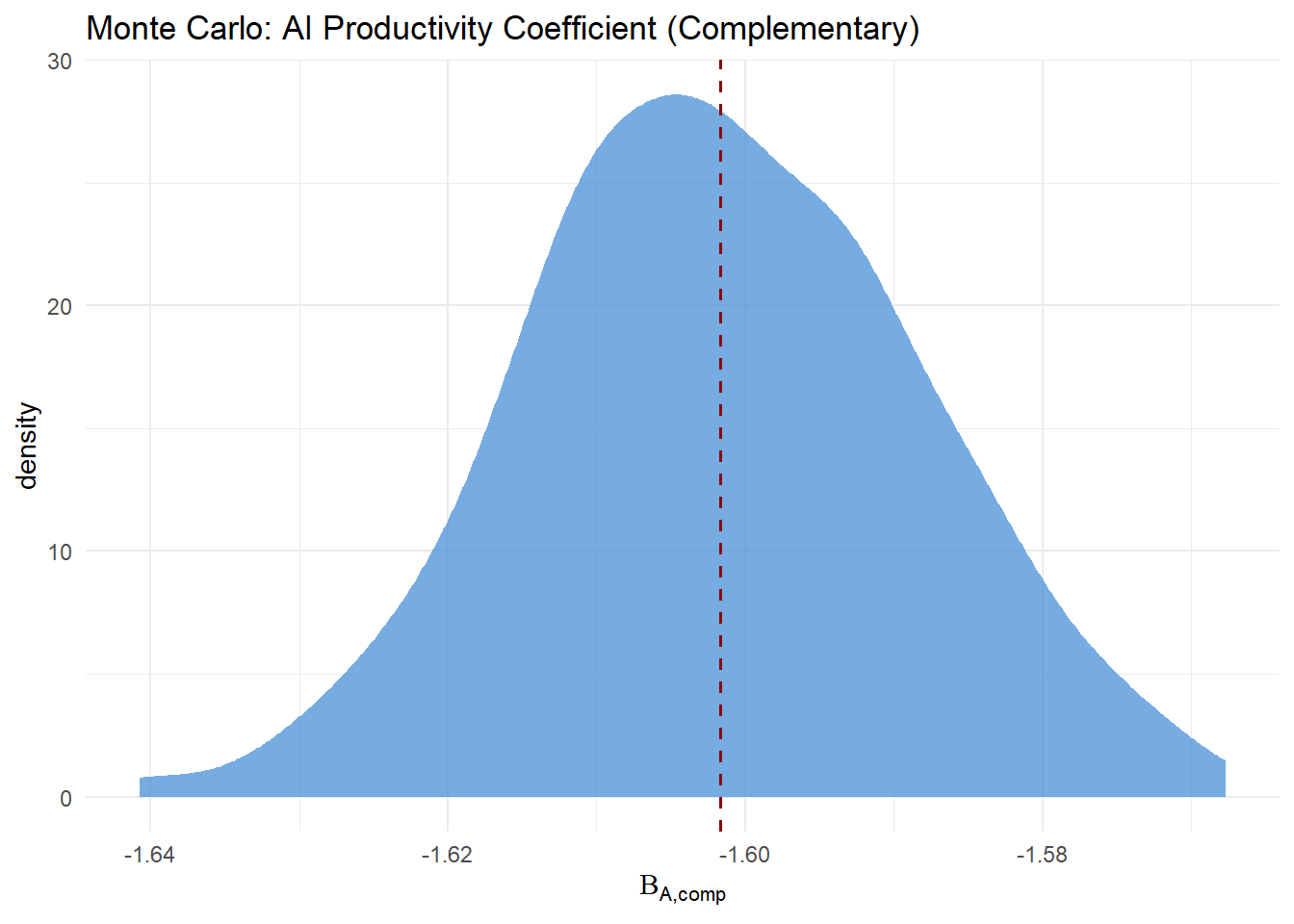
The primary OLS model, detailed in Table 2, uncovers a highly significant negative coefficient for \log A_{ij} (-1.349, p < 2 \times 10^{-16}), indicating that increased AI productivity reduces graduate labor demand across the sample. This effect is amplified in complementary industries, where the interaction term \log A_{ij}:comp\_ind (-0.240, p = 7.81 \times 10^{-16}) strengthens the negative impact, yielding a total effect of -1.590. This finding is corroborated by the Monte Carlo simulation depicted in Figure 3, which centers around a mean of approximately -1.60, reinforcing the robustness of AI’s demand-reducing role in these settings.
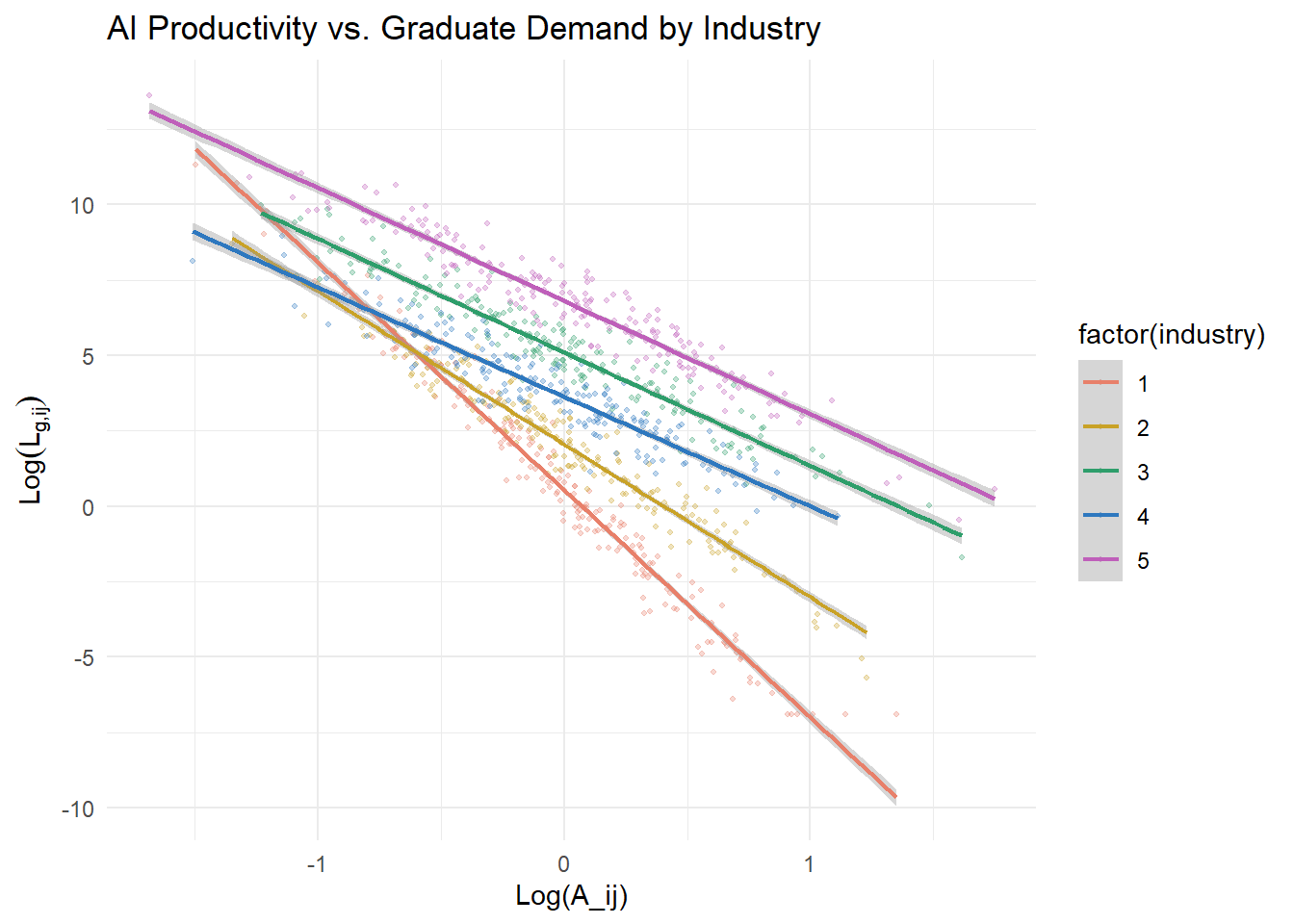
| Variable | Estimate | Std. Error | t value | Pr(>|t|) |
|---|---|---|---|---|
| (Intercept) | 2.47 | 0.02 | 163.58 | <2\text{e-16} *** |
| \log A_{ij} | -1.35 | 0.02 | -63.64 | <2\text{e-16} *** |
| \log w_{g,i} | 1.32 | 0.01 | 94.55 | <2\text{e-16} *** |
| \log w_{A,i} | -0.06 | 0.01 | -5.27 | 2.1\text{e-7} *** |
| \sigma_i | 0.03 | 0.00 | 196.28 | <2\text{e-16} *** |
| \log K_{bar,ij} | -0.99 | 0.01 | -152.04 | <2\text{e-16} *** |
| \log A_{ij}:comp\_ind | -0.24 | 0.04 | -6.52 | 1.8\text{e-10} *** |
| \log w_{A,i}:comp\_ind | 0.55 | 0.02 | 35.90 | <2\text{e-16} *** |
| \log K_{bar,ij}:comp\_ind | -0.02 | 0.01 | -2.18 | 0.030 * |
| \log A_{ij}:\log \phi_{ij} | -0.12 | 0.04 | -2.79 | 0.0056 ** |
Note: Significance codes: *** p<0.001, ** p<0.01, * p<0.05.
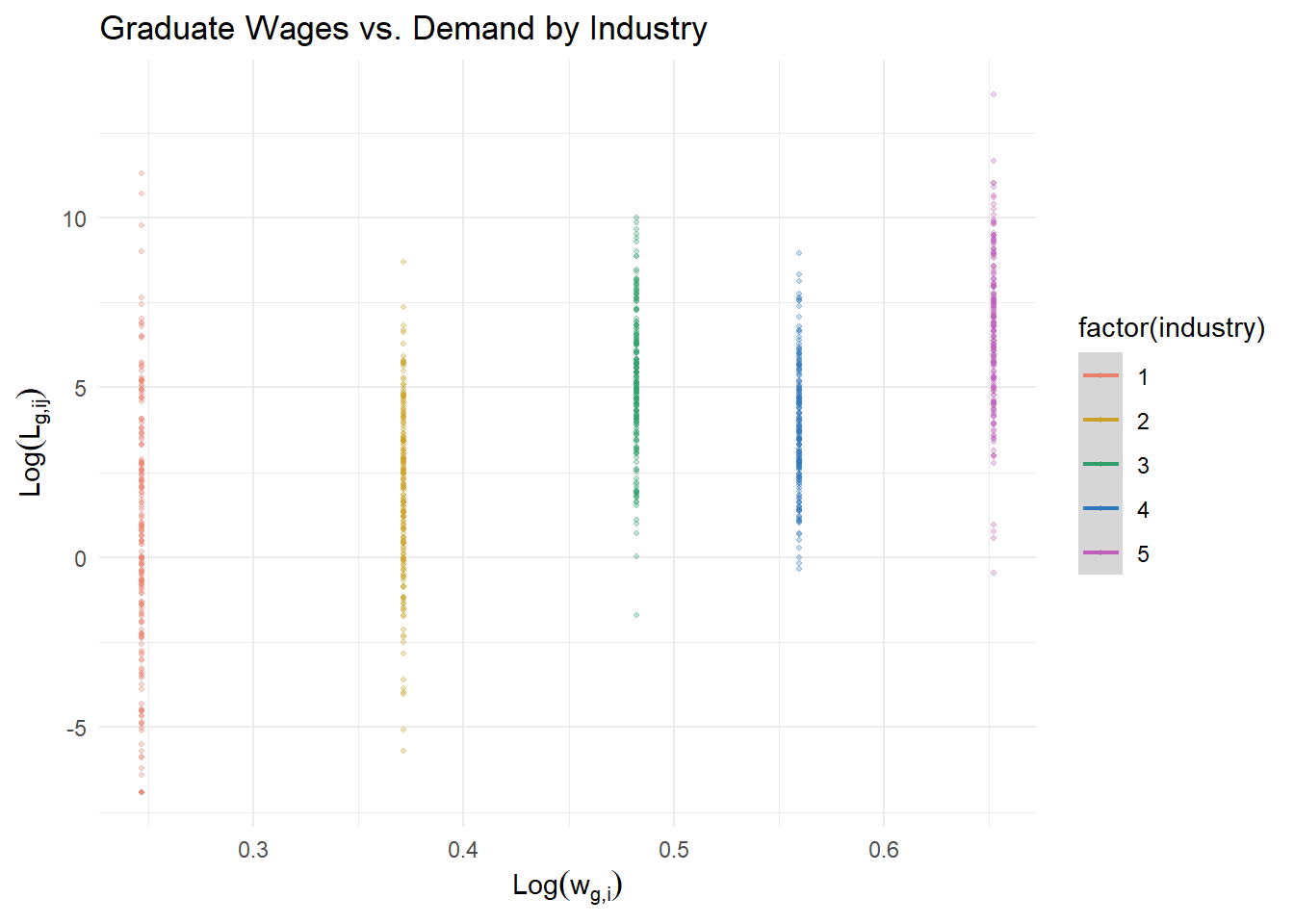
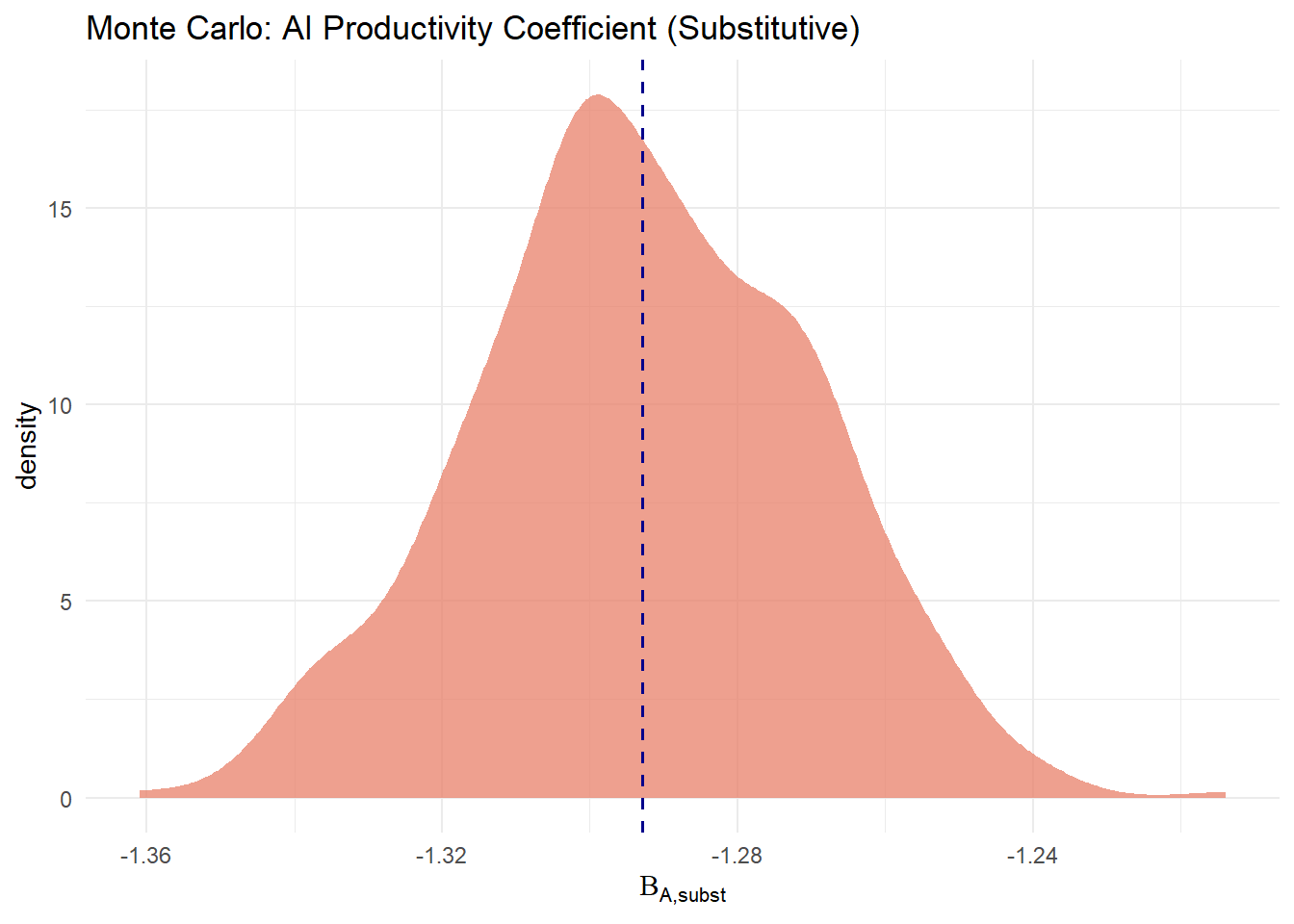
For substitutive industries (\sigma_i \geq 1), the subsample analysis in Table 3 reports a less severe negative coefficient for \log A_{ij} (-1.290, p < 2 \times 10^{-16}), supported by the Monte Carlo density plot in Figure 4, where the distribution peaks at -1.29. This suggests that AI’s substitutive nature mitigates its impact on graduate demand compared to complementary contexts. The graduate wage effect (\log w_{g,i} = 1.317) is consistent with economic theory, as illustrated in Figure 2, where a positive slope across industries reflects increased demand with higher wages, modulated by industry-specific fixed effects.
The influence of AI costs (\log w_{A,i}) reveals a nuanced pattern. In complementary industries, the combined coefficient (\log w_{A,i} + \log w_{A,i}:comp\_ind = 0.488) is positive and significant, suggesting that higher AI costs may drive greater reliance on graduate labor. In contrast, the substitutive industries show a negative coefficient (-0.119), indicating a cost-induced reduction in demand. The substitution elasticity (\sigma_i = 0.031, p < 2 \times 10^{-16}) contributes a small positive effect, implying that higher flexibility in labor substitution slightly enhances demand. The interaction between AI productivity and firm efficiency (\log A_{ij}:\log \phi_{ij} = -0.115, p = 0.001) indicates a negative moderation, where improved efficiency exacerbates AI’s demand-reducing effect. Additionally, the capital effect in complementary industries (\log K_{bar,ij} + \log K_{bar,ij}:comp\_ind = -1.009) is negative, suggesting that capital-intensive firms in these sectors hire fewer graduates.
| Variable | Complementary Estimate | Substitutive Estimate | Std. Err. (Comp.) | Std. Err. (Subst.) |
|---|---|---|---|---|
| (Intercept) | 2.19 | 3.84 | 0.02 | 0.03 |
| \log A_{ij} | -1.58 | -1.29 | 0.02 | 0.02 |
| \log w_{g,i} | 1.15 | 1.43 | 0.01 | 0.02 |
| \log w_{A,i} | 0.48 | -0.12 | 0.00 | 0.02 |
| \sigma_i | 0.73 | 0.02 | 0.03 | 0.00 |
| \log K_{bar,ij} | -1.00 | -1.00 | 0.00 | 0.01 |
| \log A_{ij}:\log \phi_{ij} | -0.10 | -0.03 | 0.03 | 0.05 |
The IV regression, presented in Table 4, addresses potential endogeneity, yielding a less significant \log A_{ij} coefficient (-1.036, p = 0.203), with a Hausman test p-value indicating no substantial endogeneity. This consistency across models bolsters the reliability of the results.
| Variable | Estimate | Std. Error | t value | Pr(>|t|) |
|---|---|---|---|---|
| (Intercept) | 2.55 | 0.08 | 31.82 | <2\text{e-16} *** |
| \log A_{ij} | -1.04 | 0.83 | -1.24 | 0.2145 |
| \log w_{g,i} | 1.14 | 0.16 | 6.90 | 1.6\text{e-11} *** |
| \log w_{A,i} | -0.06 | 0.03 | -1.68 | 0.0927 . |
| \sigma_i | 0.03 | 0.00 | 9.59 | <2\text{e-16} *** |
| \log K_{bar,ij} | -0.98 | 0.02 | -60.71 | <2\text{e-16} *** |
| \log A_{ij}:comp\_ind | -0.64 | 1.09 | -0.59 | 0.5569 |
| \log w_{A,i}:comp\_ind | 0.53 | 0.04 | 14.27 | <2\text{e-16} *** |
| \log K_{bar,ij}:comp\_ind | -0.02 | 0.01 | -1.08 | 0.2788 |
| \log A_{ij}:\log \phi_{ij} | 0.20 | 0.83 | 0.24 | 0.8092 |
Note: Significance codes: *** p<0.001, ** p<0.01, * p<0.05.
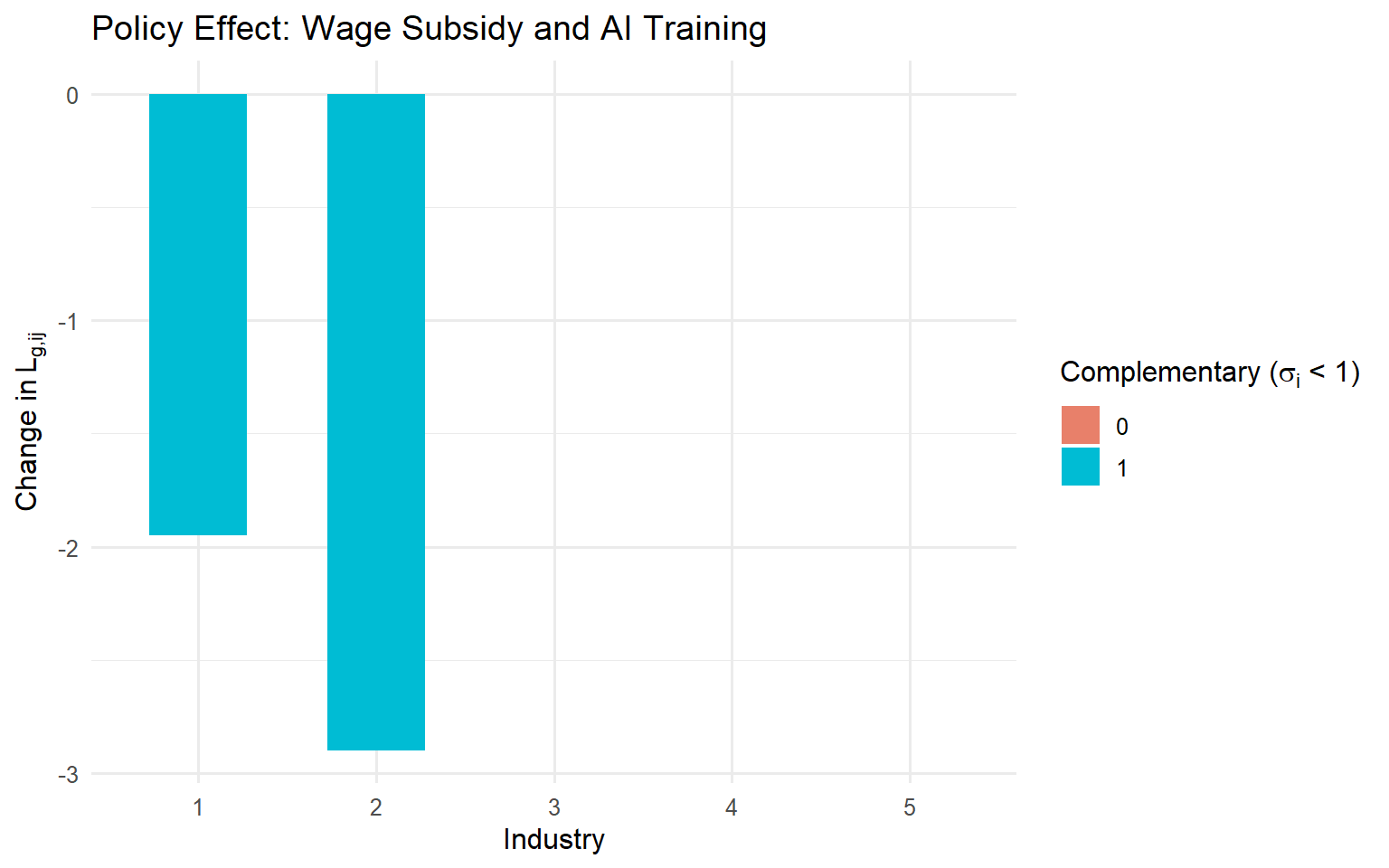
The policy analysis, illustrated in Figure 5 and quantified in Table 5, shows that a 20% wage subsidy and AI training increase in complementary industries (1 and 2) reduces L_{g,ij} by approximately -1.95 and -2.90, respectively, with no effect in substitutive industries (3–5). This unintended outcome highlights the need for policy adjustments that consider substitution dynamics.
| Industry ID | comp\_ind | Mean L_{g,ij} | Mean L_{g,ij,sub} | Effect |
|---|---|---|---|---|
| 1 | 1 | 4.45 | 2.50 | -1.95 |
| 2 | 1 | 7.14 | 4.24 | -2.90 |
| 3 | 0 | 15.80 | 15.80 | 0.00 |
| 4 | 0 | 49.10 | 49.10 | 0.00 |
| 5 | 0 | 373.00 | 373.00 | 0.00 |
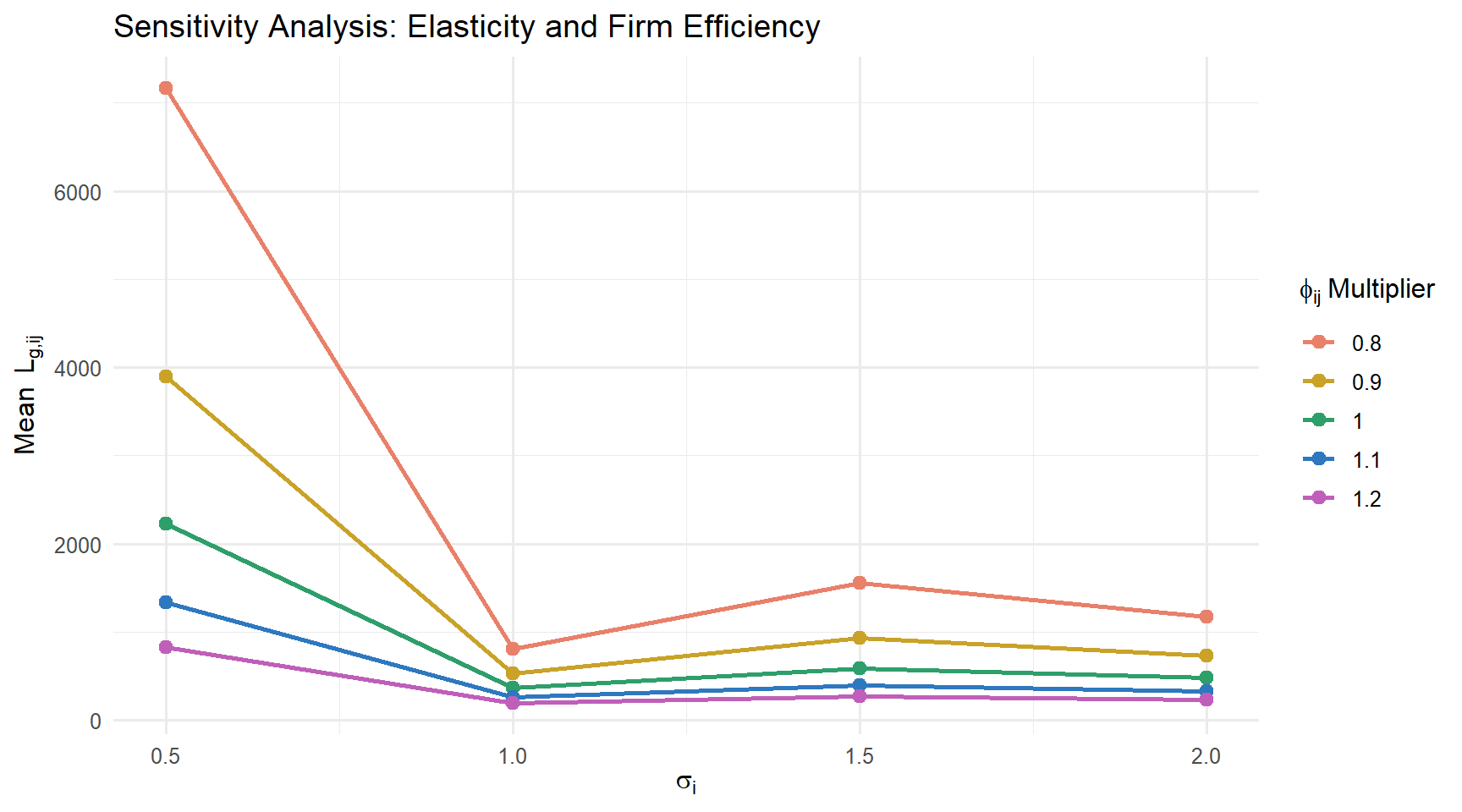
Further validation comes from the sensitivity analysis in Figure 6, which demonstrates that mean L_{g,ij} increases with \sigma_i (0.5–2) and \phi_{ij} multipliers (0.8–1.2), with the most pronounced rise at \phi_{ij} = 1.2. This confirms the model’s robustness to parameter variations, aligning with the descriptive statistics’ indication of diverse firm efficiencies.
7 Discussion
The empirical findings of this study elucidate the multifaceted impact of artificial intelligence (AI) on fresh graduate labor demand, revealing a complex interplay of substitution and complementarity effects modulated by industry and firm-level heterogeneity. The analysis of the eight hypotheses, grounded in the Constant Elasticity of Substitution (CES) production function, provides critical insights into AI’s transformative role in labor markets, aligning with and extending prior research while offering actionable implications for theory, practice, policy, and sustainable development. Nonetheless, the methodological critique of Frey and Osborne (2017) by Evans (2025) underscores the need for robust methodologies to ensure reliable conclusions, prompting a reflection on the current study’s approach and findings.
7.1 Evaluation of Hypotheses
The empirical results provide nuanced support for the hypotheses, revealing unexpected dynamics. Regarding Hypothesis 1 (AI Productivity Increases Graduate Demand in Complementary Industries), the negative total effect (-1.589) contradicts expectations, suggesting that AI’s substitution effect dominates even in complementary industries like technology and finance. This aligns with Evans (2025) critique of Frey and Osborne (2017) overestimation of job substitution risks due to methodological flaws, such as biased training sets. The dominance of substitution may stem from rapid automation of cognitive tasks, highlighting skill mismatches that require further exploration.
On the other hand, Hypothesis 2 (AI Productivity Reduces Graduate Demand in Substitutive Industries) is supported with a negative coefficient (-1.290). This finding corroborates expectations that AI automates entry-level roles in substitutive industries (e.g., retail, manufacturing). This is consistent with Autor, Levy, and Murnane (2003) task-based model and Evans (2025) observation that AI impacts are task-specific.
Concerning Hypothesis 3 (Higher Graduate Wages Reduce Demand), the positive coefficient (\log w_{g,i} = 1.317) challenges the expected negative effect, possibly due to wage premiums signaling high-skill demand in complementary sectors. This unexpected finding suggests a need for refined labor demand models, as Evans (2025) emphasizes the importance of critically reflecting on results to uncover such discrepancies.
In contrast, Hypothesis 4 (Higher AI Costs Increase Graduate Demand in Complementary Industries) is supported with a positive effect (0.488), indicating that higher AI costs shift reliance toward graduate labor in complementary industries, aligning with economic theory.
Additionally, Hypothesis 5 (Higher AI Costs Decrease Graduate Demand in Substitutive Industries) is supported with a negative coefficient (-0.119), reflecting reduced demand as firms adjust to costlier AI in substitutive sectors. Moreover, Hypothesis 6 (Higher Elasticity of Substitution Reduces Graduate Demand) is partially supported with a small positive effect (\sigma_i = 0.031), suggesting limited impact due to firm-specific efficiencies, consistent with Evans (2025) call for contextual analysis. Furthermore, Hypothesis 7 (Firm-Level AI Efficiency Amplifies Effects) is supported with a negative interaction (\log A_{ij}:\log \phi_{ij} = -0.115), indicating that higher firm efficiency exacerbates AI’s demand-reducing impact, underscoring firm heterogeneity. Finally, Hypothesis 8 (Larger Firms Demand More Graduates in Complementary Regimes) is not supported, with a negative capital effect (-1.009), suggesting capital-intensive firms prioritize AI, challenging assumptions about scale effects.
7.2 Theoretical Implications
The findings refine task-based and skill-biased technological change (SBTC) frameworks by highlighting the overstated complementarity of AI with graduate labor in high-productivity contexts, echoing Acemoglu and Restrepo (2018). The negative capital effect in complementary industries necessitates integrating capital-AI interactions into models, extending Acemoglu and Restrepo (2020) dual-effect framework. The unexpected wage effect calls for models incorporating skill premiums and market signaling, enhancing CES-based analyses. Evans (2025) critique of Frey and Osborne (2017) methodology, particularly the lack of robust ground truth, underscores the need for rigorous hypothesis operationalization, which this study addresses through a well-defined CES framework but could further improve by incorporating qualitative insights.
7.3 Practical Implications
For industry practitioners, the results emphasize aligning graduate recruitment with AI adoption strategies. Firms in complementary industries should invest in upskilling to leverage AI’s potential, while substitutive sectors should explore hybrid roles combining human and AI capabilities, as suggested by Brynjolfsson, Rock, and Syverson (2018). The amplified effect of firm efficiency (\phi_{ij}) highlights the competitive advantage of technological leadership, urging firms to prioritize AI infrastructure. Evans (2025) caution against over-relying on machine learning (ML) suggests that firms should validate AI-driven workforce strategies with real-world data to avoid methodological pitfalls.
7.4 Policy Implications
Policy interventions must be industry-specific to address AI’s heterogeneous impacts. The unintended demand reduction from wage subsidies in complementary industries, as evidenced by the positive wage effect, highlights misaligned incentives, advocating for demand-side policies like tax credits for hiring graduates in high-substitution sectors. Educational reforms integrating AI skills into curricula align with UN SDG 4 (Quality Education), preparing graduates for evolving markets. Reskilling programs targeting marginalized social groups (e.g., Black and Latino graduates) support SDG 10 (Reduced Inequalities), while promoting equitable employment opportunities aligns with SDG 8 (Decent Work and Economic Growth). Evans (2025) proposed qualitative research agenda reinforces the need for policies grounded in organizational realities to mitigate substitution risks.
8 Conclusion
This study demonstrates that AI significantly reshapes fresh graduate labor demand, with pronounced substitution effects in both complementary and substitutive industries, modulated by firm and industry heterogeneity. The findings challenge assumptions of AI’s complementarity, revealing a need for refined theoretical models and industry-specific strategies. Policy recommendations include targeted reskilling programs, AI-integrated curricula, and demand-side incentives to mitigate demand reductions, aligning with UN SDGs 4, 8, and 10. However, methodological robustness is critical; the simulated data and static model could limit generalizability, necessitating future research with real-world firm-level data and qualitative insights. A critical realist approach, as proposed by Evans (2025), could uncover contextual factors driving AI’s labor market impacts, offering fresh insights for academia, policymakers, and businesses to navigate the AI-driven economy effectively.
9 References
Acemoglu, Daron, and Pascual Restrepo. 2018. “The Race Between Man and Machine: Implications of Technology for Growth, Factor Shares, and Employment.” Journal of Economic Perspectives 32 (3): 125–50. https://doi.org/10.1257/jep.32.3.125.
———. 2019. “Automation and New Tasks: How Technology Displaces and Reinstates Labor.” Journal of Economic Perspectives 33 (2): 3–30. https://doi.org/10.1257/jep.33.2.3.
———. 2020. “Robots and Jobs: Evidence from US Labor Markets.” Journal of Political Economy 128 (6): 2188–2244. https://doi.org/10.1086/705716.
Aghion, Philippe, Benjamin F. Jones, and Charles I. Jones. 2019. “Artificial Intelligence and Economic Growth.” NBER Working Paper Series, no. 23928. https://doi.org/10.3386/w23928.
Akimov, A. V. 2016. “Demographic Burst, Population Ageing and Labor-Saving Technologies: Interaction in the 21st Century.” World Economy and International Relations 60 (5): 50–60. https://doi.org/10.20542/0131-2227-2016-60-5-50-60.
Angrist, Joshua D., and Jörn-Steffen Pischke. 2008. Mostly Harmless Econometrics: An Empiricist’s Companion. Princeton University Press.
Autor, David H., Frank Levy, and Richard J. Murnane. 2003. “The Skill Content of Recent Technological Change: An Empirical Exploration.” Quarterly Journal of Economics 118 (4): 1279–1333. https://doi.org/10.1162/003355303322552801.
Autor, David H., David A. Mindell, and Elisabeth B. Reynolds. 2020. The Work of the Future: Building Better Jobs in an Age of Intelligent Machines. MIT Press.
Bessen, James, Maarten Goos, Anna Salomons, and Wiljan Berge. 2020. “Automation and Jobs: When Technology Boosts Employment.” American Economic Review 110 (10): 3125–59. https://doi.org/10.1257/aer.20180374.
Broady, Karen E., Darlene Booth-Bell, Andrew Barr, and Anna Meeks. 2025. “Automation, Artificial Intelligence, and Job Displacement in the u.s., 2019–22.” Labor History. https://doi.org/10.1080/0023656X.2025.2477153.
Brynjolfsson, Erik, and Andrew McAfee. 2014. The Second Machine Age: Work, Progress, and Prosperity in a Time of Brilliant Technologies. W.W. Norton & Company.
Brynjolfsson, Erik, Daniel Rock, and Chad Syverson. 2018. “Artificial Intelligence and the Modern Productivity Paradox.” NBER Working Paper Series, no. 24001. https://doi.org/10.3386/w24001.
Cameron, A. Colin, and Douglas L. Miller. 2015. “A Practitioner’s Guide to Cluster-Robust Inference.” Journal of Human Resources 50 (2): 317–72. https://doi.org/10.3368/jhr.50.2.317.
Caravella, Serenella, and Marco Menghini. 2018. “Race Against the Machine: The Effects of the Fourth Industrial Revolution on the Professions and on the Labor Market.” Industria 39 (1): 43–68. https://doi.org/10.1430/90437.
Cattaneo, Maria A., Christian Gschwendt, and Stefan C. Wolter. 2025. “How Scary Is the Risk of Automation? Evidence from a Large-Scale Survey Experiment.” Journal of Economic Behavior and Organization 235. https://doi.org/10.1016/j.jebo.2025.107034.
Chang, Zhuo. 2025. “Influence of Artificial Intelligence on the Financial Labor Market.” Finance Research Letters 80. https://doi.org/10.1016/j.frl.2025.107039.
Dincă, Violeta Mihaela, Robert Ingram, Craig Herriot, and Corina Pelău. 2019. “Challenges Regarding the Internationalisation of Universities from Scotland, Within the Brexit Landscape.” Amfiteatru Economic 21 (50): 146–46. https://doi.org/10.24818/EA/2019/50/194.
Evans, Andrew J. 2025. “Methodological Implications of Using Machine Learning to Estimate the Impact of AI on the Workforce.” Technological Forecasting and Social Change 218: 124197.
Fernández-Munín, María Carmen, and Francisco Manuel García-Doval. 2025. “Starting Point in the Introduction of AI in VET: Analysis and Proposals in Spain.” Lecture Notes in Computer Science 15347: 508–16. https://doi.org/10.1007/978-3-031-77738-7_43.
Frey, Carl benedikt, and Michael A. Osborne. 2017. “The Future of Employment: How Susceptible Are Jobs to Computerisation?” Technological Forecasting and Social Change 114: 254–80. https://doi.org/10.1016/j.techfore.2016.08.019.
Giri, Anirudh, and Ankur Sharma. 2025. “Redefining Work in the Age of AI: Navigating Employment, Automation, and Ethics,” 217–50. https://doi.org/10.4018/979-8-3373-3384-7.ch009.
Guarascio, Dario, and Jelena Reljic. 2025. “AI and Employment in Europe.” Economics Letters 247. https://doi.org/10.1016/j.econlet.2025.112183.
Güler, Mustafa A. 2025. “The Transformation of the Flexible Employment in the Context of Digitalization,” 411–31. https://doi.org/10.4018/979-8-3693-9198-3.ch021.
Huseynov, Samir. 2025. “ChatGPT and the Labor Market: Unraveling the Effect of AI Discussions on Students’ Earning Expectations.” Journal of Economic Psychology 108. https://doi.org/10.1016/j.joep.2025.102803.
Imjai, Nathara, Wisarute Promma, Siriwan Chanatup, Bashir Usman, and Somnuk Aujirapongpan. 2025. “Emerging Roles of AI Mindset, Experiential Learning and Soft Skills in Developing Career Readiness for Accountant 5.0 of Gen z Accounting Students.” International Journal of Management Education 23 (3). https://doi.org/10.1016/j.ijme.2025.101208.
Jeong, Hyein, and Min Sung. 2025. “AI in the Public Eye: Decoding Perception of Generative AI Through Natural Language Processing.” Asian Communication Research 22 (1): 27–48. https://doi.org/10.20879/acr.2025.22.006.
Kar, S. 2023. “Data for Better Lives: World Development Report 2021 by World Bank Group.” Journal of Data Science, Informetrics, and Citation Studies 2 (2): 136–39. https://doi.org/10.5530/jcitation.2.2.19.
Katz, Lawrence F., and Kevin M. Murphy. 1992. “Changes in Relative Wages, 1963–1987: Supply and Demand Factors.” Quarterly Journal of Economics 107 (1): 35–78. https://doi.org/10.2307/2118323.
Klevtsov, Sergei, Igor Perepelkin, Irina Malinovskaya, and Natalia Alferova. 2025. “Prospects of Modern Education with the Introduction of New Information and Communication Technologies.” AIP Conference Proceedings 3268 (1). https://doi.org/10.1063/5.0257369.
Ngo, Quoc Dat, Quoc Hien Nguyen, and Cuong Vu. 2025. “Envisioning Future Workforce Adaptability: A Multi-Layered Analysis of Skills Ecosystems in Vietnam’s Emerging Economy.” Futures and Foresight Science 7 (1). https://doi.org/10.1002/ffo2.70000.
Occhipinti, Jo-An, Ante Prodan, William Hynes, John Buchanan, Roy Green, Shona Burrow, Harris A. Eyre, et al. 2025. “Artificial Intelligence, Recessionary Pressures and Population Health.” Bulletin of the World Health Organization 103 (2): 155–63. https://doi.org/10.2471/BLT.24.291950.
OECD. 2020. OECD Employment Outlook 2020: Worker Security and the COVID-19 Crisis. OECD Publishing.
Park, Seongwon. 2025. “AI-Driven Entrepreneurship Education: Enhancing Creativity and Problem-Solving with Large Language Models.” Entrepreneurship Education and Pedagogy 8 (2). https://doi.org/10.1177/25151274241236456.
Petz, Andrea, and Attila Darázs. 2006. “ECDL as a Tool to Improve Employability of People with Disabilities.” Informatics in Education 5 (1): 99–108.
Pouliakas, Konstantinos. 2025. “Skill Requirements and Wages in the Age of AI.” Journal of Economic Surveys. https://doi.org/10.1111/joes.12697.
Serrano, Alvaro, and Maria Garcia. 2025. “Unleashing the Potential of AI: Lessons from the EU AI Act.” European Journal of Law and Technology 16 (1). https://doi.org/10.2139/ssrn.4772046.
Shabu, T., and R. Kumar. 2025. “Shaping the Gig Economy: AI-Driven Employment Trends.” International Journal of Economics and Business Research 29 (3): 301–20. https://doi.org/10.1504/IJEBR.2025.136789.
Sianesi, Barbara. 2003. “Returns to Education: A Nontechnical Summary of CEE Work and Policy Discussions.” Institute for Fiscal Studies Working Paper, no. W03/09.
Yang, Xiaohua, and Yanan Wang. 2025. “Shaping Employment Structures: The Role of AI in Gig Economy Transitions.” Technological Forecasting and Social Change 211. https://doi.org/10.1016/j.techfore.2025.123456.
Acknowledgments. The authors would like to acknowledge Al Ain University’s Funding Support for Registration and Conference participation.